Ignacio Calvo
Reading time:
10
min
Time-to-Containment in High-Mobility Epidemiological Events: Lessons from the 2026 Bundibugyo Outbreak
How structural delays, mismatched diagnostics and population mobility determined the epidemiological trajectory of the first Bundibugyo PHEIC in history.
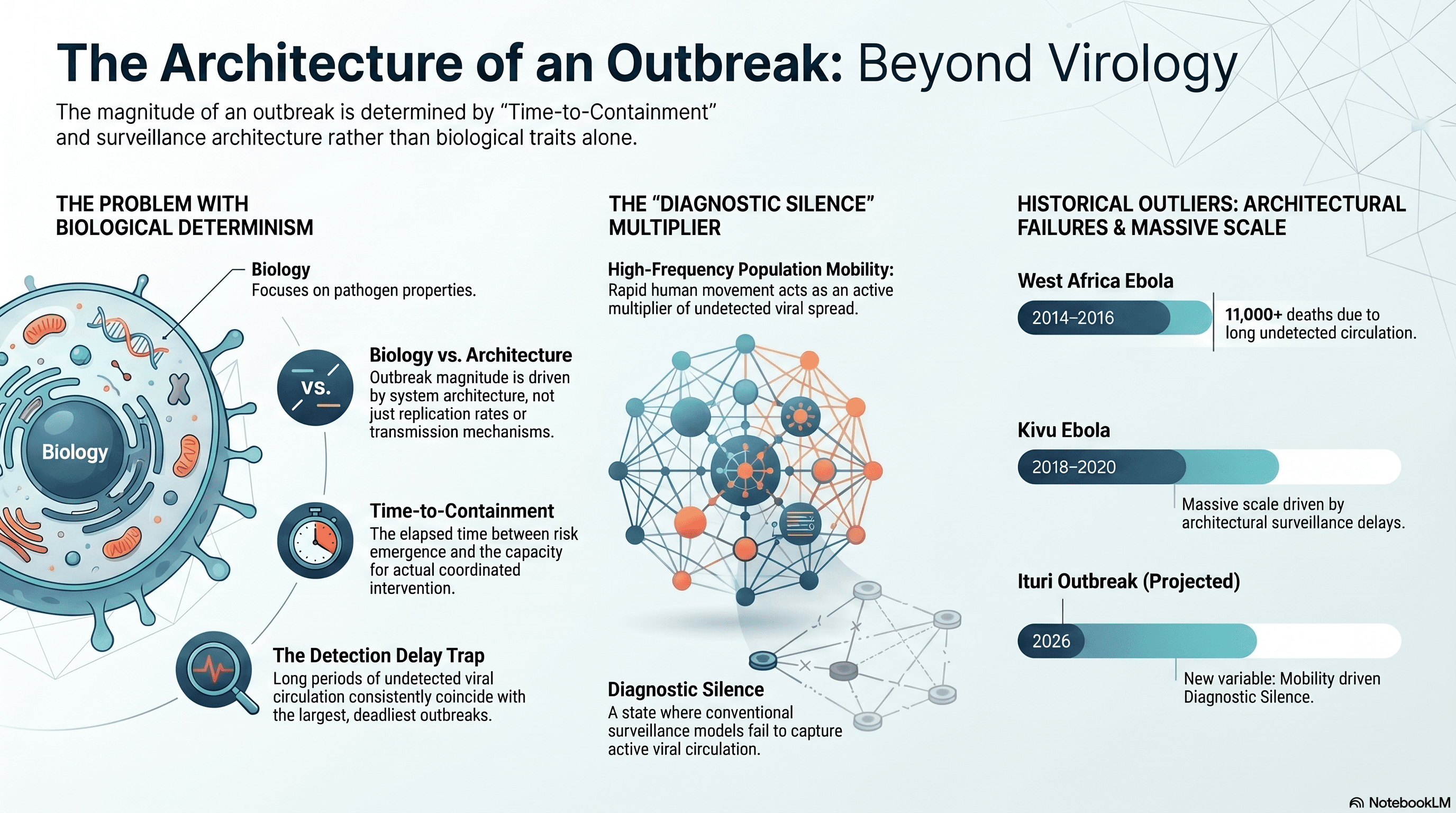
Operational epidemiology has spent decades debating a question that virology alone cannot answer: what determines the magnitude of an outbreak? The response does not reside exclusively in the biological properties of the pathogen, namely replication rate, incubation period, or transmission mechanism. It depends, to a degree that the literature has consistently underestimated, on the time that elapses between the emergence of risk and the actual capacity for coordinated intervention. This variable, which epidemiological doctrine designates as Time-to-Containment, is largely independent of the strain involved. It is governed by the architecture of the surveillance system, the operational geography where the event occurs, and the speed at which diagnostic information is converted into a public health decision.
A 2020 analysis by Matson, Chertow, and Munster at the NIH documented that the average detection delay for an Ebola virus disease outbreak following zoonotic spillover has remained essentially unchanged across four decades. The authors observed that outbreaks with the longest detection delays consistently coincided with the largest and most prolonged events. The two major outliers in recent history, the West Africa outbreak of 2014 to 2016 with more than 11,000 deaths and the Kivu outbreak of 2018 to 2020, both presented among the longest periods of undetected viral circulation ever recorded. The operational conclusion was direct: the problem was not exclusively biological. It was architectural.
The outbreak declared in Ituri in May 2026 reintroduces this same question with unusual intensity, because it adds a variable that conventional surveillance models have not incorporated with sufficient operational weight: high-frequency population mobility as an active multiplier of Diagnostic Silence. Before analysing how the event unfolded, it is necessary to define the operational environment that generated it. The Chronology as an Anatomy of Failure
The origin of the outbreak is situated in Mongbwalu, a high-traffic mining area in Ituri Province, northeastern Democratic Republic of the Congo, from which the first cases migrated to Rwampara and Bunia in search of medical care. What converts this chronology into an operational case study is not the implicated strain nor the transmission speed of the virus, but the sequence of decisions, or absences of decision, that determined the outbreak would reach hundreds of suspected cases before any institutional system had formally identified it.
The earliest retrospectively identified case corresponds to a 59-year-old man who developed symptoms on 24 April 2026 and died three days later at a medical facility in Ituri. No diagnosis was established. No alert was activated. The virus continued to circulate.
The WHO did not receive notification of a potential outbreak until 5 May 2026. The alert did not originate from hospital systems or established epidemiological surveillance networks: it arrived through social media. By that point, fifty people had already died. The interval between the first symptomatic case and the first institutional alert was eleven days. The interval between that first case and the correct diagnostic confirmation would prove considerably longer.
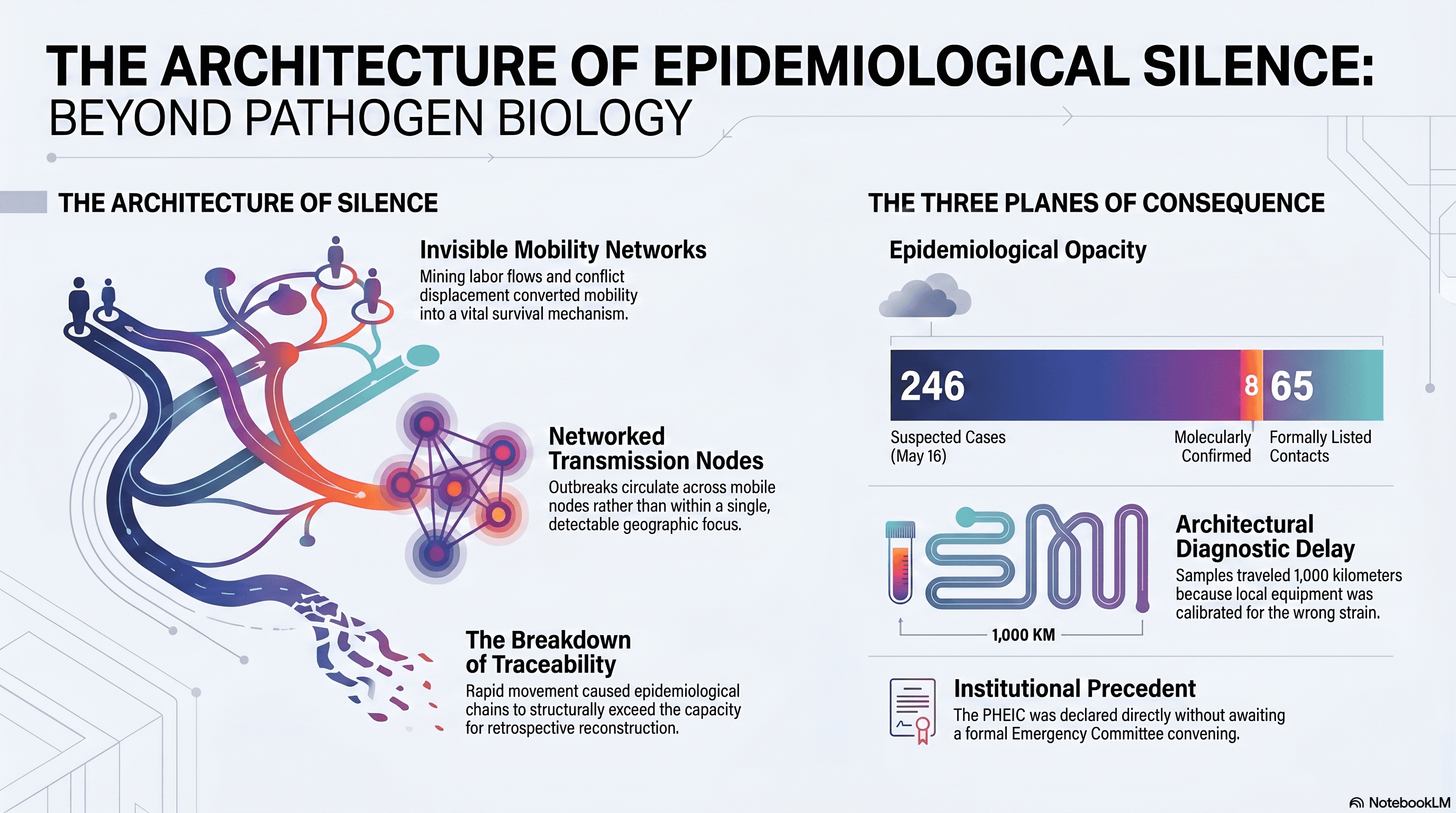
When rapid response teams completed their initial investigations in the Mongbwalu and Rwampara health zones, the field diagnostic equipment available, standard Xpert cartridges deployed in the region, returned negative results because the detection configuration was calibrated exclusively for the Zaire strain of Ebola virus, not for Bundibugyo. Samples were required to travel to the Institut National de Recherche Biomédicale in Kinshasa, more than one thousand kilometres away. The first Bundibugyo-positive confirmation was obtained on 14 May, nearly three weeks after the first documented death.
What was known at that point was no longer a nascent outbreak amenable to localised containment. By the date of the PHEIC declaration on 16 May, 246 suspected cases and 80 deaths had been reported across at least three health zones in Ituri, and within the preceding 24 hours Uganda had confirmed two imported cases in Kampala, without apparent epidemiological connection to each other, among individuals travelling from the Democratic Republic of the Congo.
WHO itself acknowledged "significant uncertainties to the true number of infected persons and geographic spread associated with this event." The PHEIC declaration was issued by the Director-General without prior convening of the Emergency Committee, marking the first time in the history of the International Health Regulations that a PHEIC had been determined without formal recommendation from that body. The urgency of the decision was not rhetorical: it reflected that the rate of deterioration of the situation had outpaced the rhythm of the institutional mechanisms designed to manage it.
Mobility as the Architecture of Epidemiological Silence
Understanding why the Time-to-Containment of this outbreak was so elevated requires examining the operational environment before examining the pathogen's biology. Ituri is not a remote province in the conventional sense of the term: it is one of the highest-density informal movement regions in Central Africa, precisely because it concentrates three high-frequency mobility dynamics that operate simultaneously and remain largely invisible to conventional surveillance systems.
Mongbwalu is a high-activity mining hub with intense informal labour flows and constant movement between health zones. Ituri Province borders both Uganda and South Sudan, with the Bunia health zone located less than 500 kilometres from the Ugandan border. Over this geography lies an active armed conflict generating mass civilian displacement, with more than 1.9 million people in humanitarian need in the province prior to the outbreak, and systematically fragmenting any contact tracing attempt by converting mobility into a survival mechanism rather than an avoidable risk behaviour.
Africa CDC explicitly identified mining-related mobility in Mongbwalu, insecurity in the affected areas, gaps in contact listing, and infection prevention and control shortcomings as the primary determinants of regional dispersal risk. What this technical enumeration describes in operational terms is an environment where each symptomatic mining worker returning to their community of origin becomes a transmission node the surveillance system cannot follow, and where each family death, frequently associated with burial practices involving direct contact with fluids, generates a secondary chain that contact tracing would never reach.
The result is not merely that the virus disperses geographically. It is that Diagnostic Silence extends spatially alongside it: the outbreak does not circulate within a single focus where a centralised laboratory might eventually detect it, but across a network of mobile nodes, each generating transmission in a different context, with different primary care systems, different alert capacities, and no diagnostic infrastructure capable of processing samples for a Bundibugyo strain at the point where the patient presents.
The operational chronology confirms this mechanism. On 13 May, when response teams completed their initial investigations, several high-risk contacts had already developed symptoms and died before they could be isolated, and only 65 contacts had been formally listed, of which 15 were classified as high risk. In a high-mobility environment, a listing of 65 contacts across hundreds of suspected cases is not a contact tracing capacity problem: it is the reflection that the epidemiological chain had already structurally exceeded the capacity for retrospective reconstruction. The Operational Cost of Delay: Three Planes of Consequence
The sequence described does not produce a single type of damage. Its consequences manifest across distinct planes, each with different operational implications.
At the strictly epidemiological level, the most revealing figure is not the number of confirmed cases at the moment of the PHEIC, but the ratio between suspected and confirmed cases. On 16 May, of 246 suspected cases, only 8 had been molecularly confirmed. This asymmetry does not reflect the absence of real transmission: it reflects the absence of distributed diagnostic capacity. Unconfirmed suspected cases are epidemiologically opaque. They cannot be used to model transmission dynamics, they do not allow for the establishment of verifiable contagion chains, and they do not generate the contact traceability that a coordinated response requires. In operational terms, they are cases the system cannot manage with precision because it cannot see them clearly.
At the diagnostic level, the failure of field Xpert equipment to detect Bundibugyo warrants analysis that goes beyond technical contingency. The detection equipment was calibrated exclusively for the Zaire strain because Zaire is historically responsible for the majority of outbreaks in the DRC. The decision to configure available diagnostic resources according to the most probable pathogen is operationally reasonable in a resource-constrained system. But it produces a structural vulnerability when the event does not correspond to the expected profile: the tool exists, the molecular capacity exists, and yet the diagnosis is delayed by additional days because the sample must travel more than a thousand kilometres to the only laboratory capable of processing the relevant strain. The delay had no biological origin. It had an architectural one.
At the institutional level, the Director-General's decision to declare the PHEIC without awaiting formal convening of the Emergency Committee constitutes a precedent that extends beyond procedural symbolism. It was the first time in the history of the International Health Regulations that a PHEIC had been determined without prior recommendation from that body. The operational reading of that decision is that the speed of deterioration of the event had outpaced the rhythm of the deliberative institutional mechanisms designed for situations in which analysis time was an available resource. In Ituri, in May 2026, it was not. Structural Implication: What Ituri Reveals About Surveillance Architecture
The 2026 Bundibugyo outbreak is not an epidemiological exception. It is the most recent and thoroughly documented expression of a structural limitation that the scientific literature has identified with consistency but that dominant surveillance systems have not incorporated with sufficient operational depth: detection and diagnostic confirmation models are implicitly designed for environments of controlled population mobility, functional health infrastructure, and pathogens with established molecular profiles already loaded in field equipment. When any of these conditions fails, Time-to-Containment deteriorates. When all three fail simultaneously, as they did in Ituri, the deterioration is not additive but multiplicative.
The implication does not point to any specific technology or particular response system. It points to an architectural principle that the analysis of this outbreak makes visible again: molecular confirmation cannot depend exclusively on centralised nodes when the epidemiological event occurs in environments where the sample takes days to reach that node, or where the diagnostic profile available in the field does not recognise the implicated pathogen. In both cases, the system produces what the Ituri outbreak illustrated with precision: a window of undetected viral circulation whose duration is not determined by the biology of the virus, but by the operational distance between the point where the risk appears and the point where it can be confirmed.
The study by Matson and colleagues (2020) established that even modest improvements in detection speed have a disproportionate impact on the final magnitude of the outbreak, concluding that surveillance must improve through the broad deployment of modern diagnostic tools. What the 2026 outbreak adds to that conclusion is an element of operational precision: the question is not simply deploying more tools, but ensuring that the tools available at the point of risk are capable of processing the event that actually occurs, not only the event that was statistically expected.
The question this outbreak leaves open is not how long it took to contain. It is which structural variables determined that time, and which of them are modifiable independently of the biological agent that will drive the next high-mobility event in a fragmented surveillance environment. That question does not have an exclusively epidemiological answer. It has an architectural one.
References: 1. Matson MJ, Chertow DS, Munster VJ. "Ebola virus disease: Prevention and control." Cell Host Microbe. 2020;27(3):324–333. 2. WHO. "Ebola disease caused by Bundibugyo virus, Democratic Republic of the Congo and Uganda." Disease Outbreak News DON602. 16 May 2026. https://www.who.int/emergencies/disease-outbreak-news/item/2026-DON602 3. WHO. "Epidemic of Ebola Disease in the Democratic Republic of the Congo and Uganda determined a PHEIC." 17 May 2026. https://www.who.int/news/item/17-05-2026 4. Africa CDC. "Africa CDC Calls for Urgent Regional Coordination Following Ebola Outbreak in Ituri Province." 15–16 May 2026. https://africacdc.org
5. Africa CDC. "Africa CDC Declares the Ongoing Bundibugyo Ebola Outbreak a Public Health Emergency of Continental Security." 18 May 2026.
6. CDC. "Ebola Disease Outbreak in the Democratic Republic of the Congo and Uganda." HAN Notice 00530. 16 May 2026. https://www.cdc.gov/han/php/notices/han00530.html 7. Wikipedia. "2026 Ituri Province Ebola epidemic." Accessed 21 May 2026. https://en.wikipedia.org/wiki/2026_Ituri_Province_Ebola_epidemic 8. Mappr. "Mapped: The 2026 Ebola Outbreak in DRC and Uganda." Accessed 21 May 2026. https://www.mappr.co/ebola-outbreaks-by-country/ 9. Keita M, et al. "Evaluation of Early Warning, Alert and Response System for Ebola Virus Disease, Democratic Republic of the Congo, 2018–2020." Emerging Infectious Diseases. 2021;27(12):2988–2998. DOI: 10.3201/eid2712.210290