Ignacio Calvo
Reading time:
10
min
Diagnostic Silence in Ituri: Structural Delays and the Epidemiological Cost of Centralized Confirmation
When field diagnostics are calibrated for the wrong strain and confirmation capacity sits a thousand kilometres from the epicentre, the silence before the alert is not an absence of signal. It is a structural property of the system.
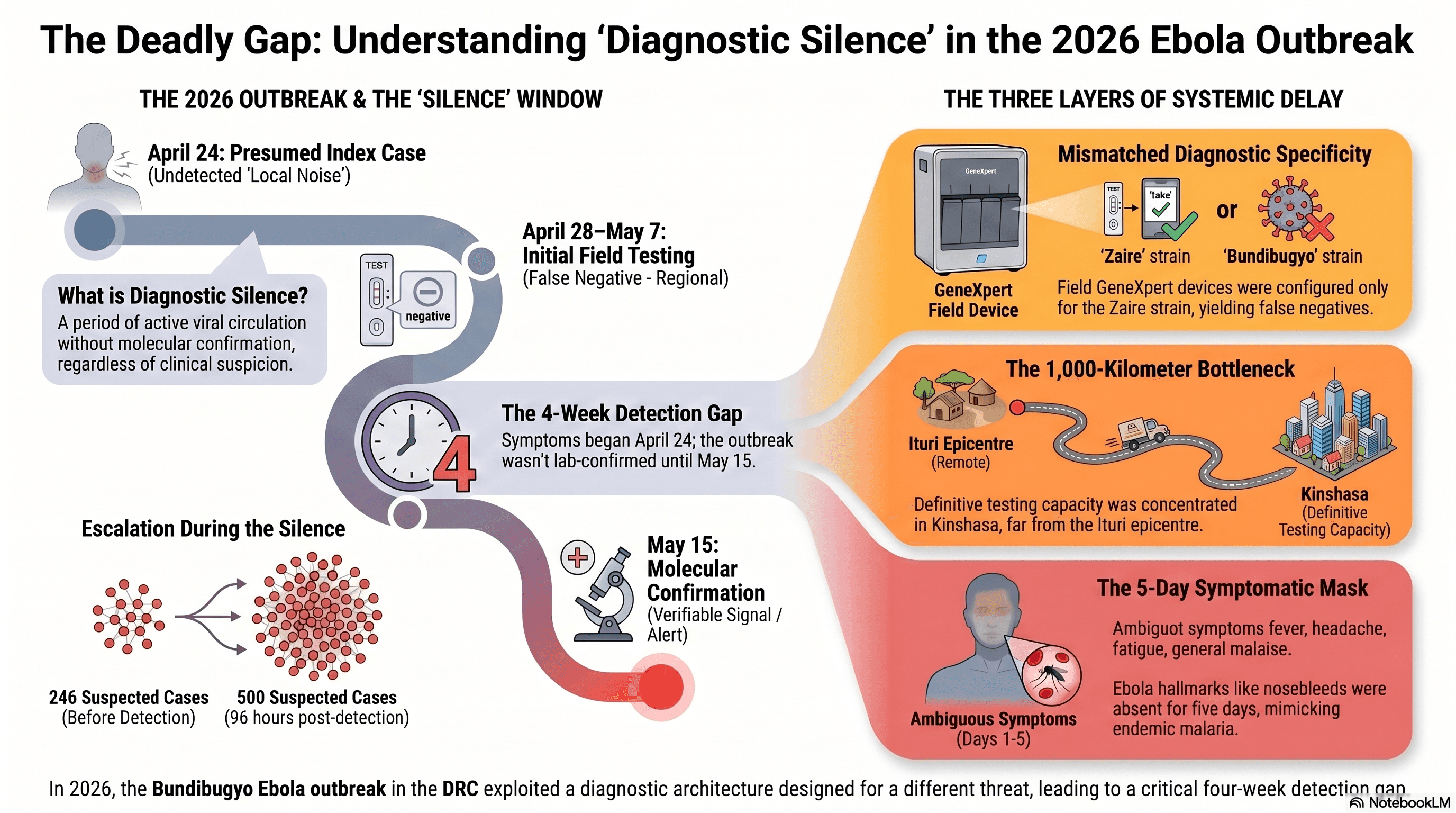
Diagnostic Silence designates the period during which a pathogen circulates actively without any molecular confirmation system being capable of identifying it. It is not the absence of clinical suspicion. In Mongbwalu, from late April 2026, physicians at the general referral hospital identified cases of severe haemorrhage and death among their own health workers. The suspicion existed. What did not exist was the capacity to convert that suspicion into a confirmed diagnosis capable of activating a coordinated response. The operational difference between those two categories, between suspecting and confirming, determines when contact tracing can begin, when isolation protocols can be activated, and when epidemiological information ceases to be local clinical noise and becomes a verifiable signal for international alert systems.
The 2026 Bundibugyo outbreak is the most thoroughly documented case of Diagnostic Silence in recent Ebola history. Not because the delay was exceptional in absolute terms, but because the sequence of mechanisms that produced it has been reconstructed with unusual precision by the institutions directly involved. Dr. Placide Mbala, head of epidemiology and global health at the INRB, was direct: the difficulties in detecting Bundibugyo in the field demonstrate why a rapid test capable of identifying the strain directly, without requiring a specialised laboratory, is urgently needed. That statement, formulated from within the system that managed the outbreak's diagnostic confirmation, is not a declaration of technological aspiration. It is the operational diagnosis of a diagnostic architecture that produced three weeks of undetected viral circulation, not because it lacked molecular capacity, but because that capacity was located in the wrong place for the pathogen that appeared.
The argument of this analysis is precise: the Diagnostic Silence of the Ituri outbreak was not a consequence of Bundibugyo's rarity as a pathogen. It was the consequence of a diagnostic system designed for a different threat profile than the one that occurred, with definitive confirmation capacity concentrated in a single node more than a thousand kilometres from the epicentre. That architecture functioned correctly for the fifteen Zaire outbreaks that preceded it. It failed systematically for the seventeenth. Three Overlapping Layers of Delay
Reconstructing the Diagnostic Silence of the Ituri outbreak requires distinguishing three independent mechanisms that operated simultaneously and whose effects accumulated, producing a window of undetected circulation that none of them, in isolation, would have generated with the same magnitude.
The first was a technical failure of diagnostic specificity with direct operational consequences. The regional health centre in Bunia had a GeneXpert device, the molecular diagnostic platform of reference for emergency settings in low-infrastructure environments. That device was configured exclusively to detect Ebola Zaire, the strain responsible for practically all previous outbreaks in the DRC. A first batch of samples collected between 28 April and 1 May in the Aru health zone tested negative in Bunia. A second batch, collected between 3 and 7 May in Rwampara, also tested negative. In Kinshasa, however, the Rwampara samples returned positive. The instrument did not malfunction. It performed exactly the function for which it was designed. The pathogen causing the outbreak simply fell outside the profile for which the instrument had been configured.
That first failure activated the second. The twenty samples collected in Rwampara and analysed at the Provincial Public Health Laboratory in Bunia using the standard Ebola Xpert returned negative results, so the samples were sent to the INRB for further analysis, where eight were confirmed as Orthoebolavirus by PCR on 15 May, with genomic sequencing confirming the species as Bundibugyo virus. Between the negative result in Bunia and the positive confirmation in Kinshasa, days elapsed that had no biological or clinical origin. They had a logistical one: the distance between the point where the event occurred and the only laboratory with the capacity to process the strain present.
The third mechanism operated in parallel with the first two and amplified their effect on the number of unidentified cases during the silence window. The WHO representative in the DRC, Dr. Anne Ancia, documented that the wide range of initial symptoms, fever, fatigue, diarrhoea, and vomiting, complicated rapid diagnosis, and that the nosebleeds associated with the disease, which in retrospect allow clinical suspicion to be oriented toward Ebola, did not appear until the fifth day of infection in most cases. In environments with high endemicity of malaria, typhoid fever, and other febrile haemorrhagic diseases, that five-day window of symptomatic ambiguity is sufficient for a case to bypass isolation protocols and generate multiple secondary exposures before the clinical profile becomes specific enough to elevate suspicion to the institutional level.
The sum of these three mechanisms produced a documented operational outcome. By the time diagnostic confirmation arrived on 14 May, the outbreak had been active for at least three weeks and had generated dozens of deaths before any institutional system had formally identified it. Matthew Kavanagh, director of the Georgetown University Center for Global Health Policy, stated it precisely: "Because early tests looked for the wrong strain of Ebola, we got false negatives and lost weeks of response time."
The Rationality That Produced the Blind Spot
Understanding why the GeneXpert in Bunia was configured for Zaire rather than Bundibugyo requires recognising that the decision was not an error. It was an operationally reasonable choice under a threat model that proved incomplete.
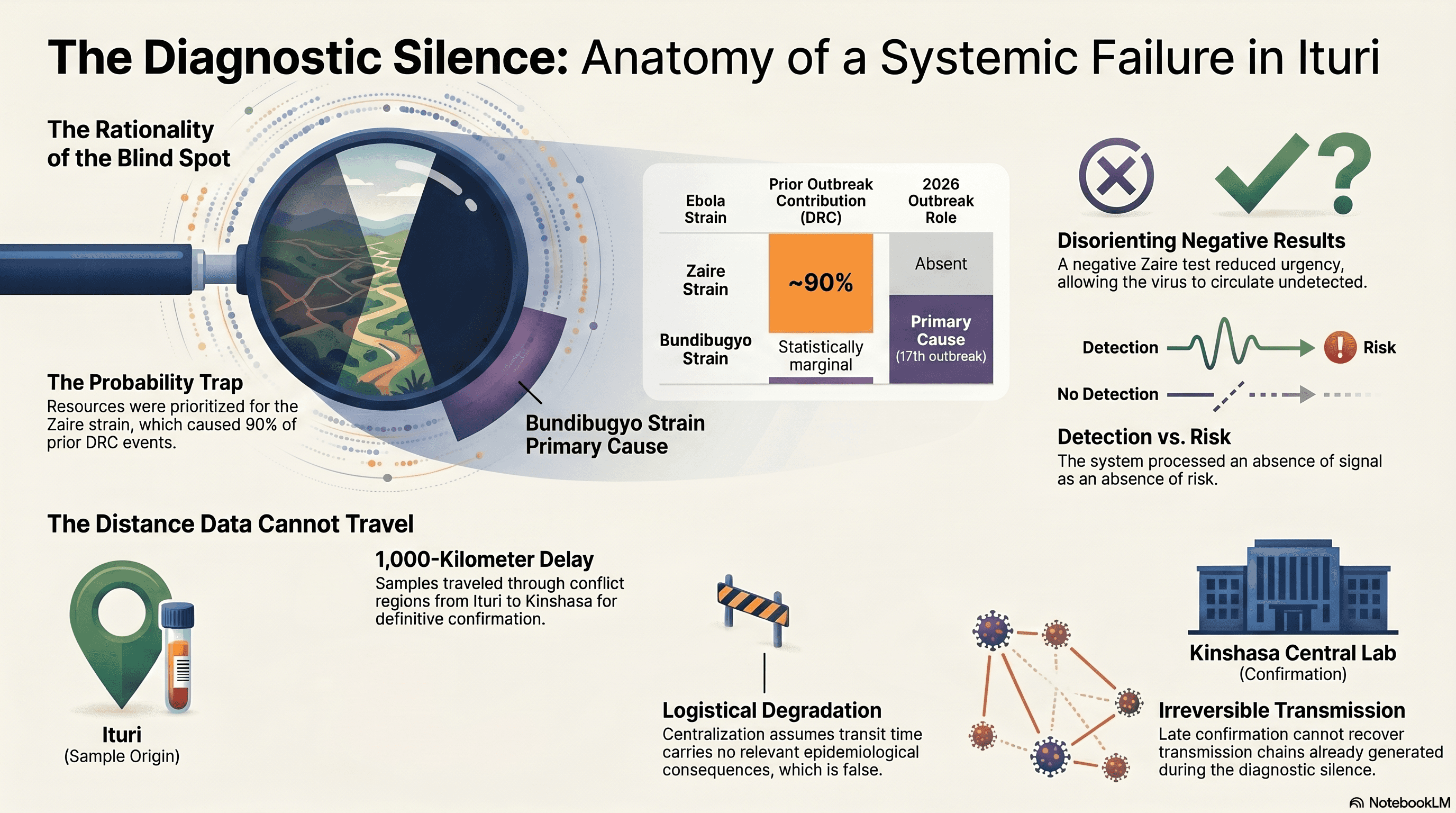
Bundibugyo is the rarest of the four orthoebola viruses known to cause disease in humans. Since its identification in 2007, it had caused only two documented outbreaks: the first in Bundibugyo District, Uganda, with 149 cases, and the second in the Isiro health zone, DRC, in 2012, with 52 cases. The prior probability that a haemorrhagic outbreak in Ituri would be caused by Bundibugyo was, given that background, statistically marginal. Zaire, by contrast, was responsible for 15 of the previous outbreaks documented in the DRC. The logic of allocating scarce diagnostic resources in low-infrastructure settings justified, with coherent reasoning, configuring available equipment for the pathogen that had caused approximately 90% of prior events in the same territory.
What the 2026 outbreak reveals is not that this logic was incorrect. It reveals that the logic carries a structural cost when the low-probability event occurs, and that cost has a specific property that conventional risk models tend to underestimate: the negative result from the Zaire-configured GeneXpert was not epidemiologically neutral. It was actively disorienting. A negative result from a reference diagnostic test reduces the perceived urgency of the event among local health teams, delays alert escalation, and generates an interval during which the virus continues to circulate while the system interprets the risk as having been ruled out. The absence of signal is not the absence of risk. It is the absence of capacity to detect that specific risk, which the system processes as though they were the same thing.
A field rapid test returning negative for Ebola in an outbreak that is, in fact, Ebola does not only fail to detect the problem: it generates the active perception that the problem does not exist, making an invisibly spreading outbreak significantly harder to contain because contact tracing is always one step behind. That observation describes with precision the mechanism by which the GeneXpert diagnostic failure did not produce only a delay in confirmation. It produced a delay in the activation of all the measures that confirmation should have triggered. The Distance the Data Cannot Travel
The second component of Ituri's Diagnostic Silence operates independently of the first and warrants autonomous analysis, because it persists even in a hypothetical scenario where the field GeneXpert had been correctly configured for Bundibugyo.
Ituri Province is more than a thousand kilometres from Kinshasa along a route crossing one of the continent's highest-density active conflict regions. Road infrastructure in northeastern Congo is severely limited. The transit of biological samples under adequate cold chain conditions between the point of detection and the reference laboratory is not an operation measured in hours. In the Ituri outbreak, it was only through testing in Kinshasa that the presence of Bundibugyo was finally revealed, after local tests in Bunia had shown negative results for the more common Zaire strain. That transit introduced days of delay that had no origin in the pathogen's biology or in the system's technical capacity, but in the centralisation architecture that concentrates definitive confirmation capacity in a single geographically distant node from the point where the risk manifests.
This is the dimension that operational epidemiology identifies as Logistical Degradation: the loss of operational value caused by dependence on transport and centralised analysis. In the case of Ituri, that degradation was not an execution problem or a human resources problem. It was a systemic design problem: the diagnostic confirmation model was built on the implicit premise that the transit time of a sample between the epicentre and the reference laboratory carries no relevant epidemiological consequences. The 2026 outbreak demonstrated that this premise is incorrect when the event occurs in a high population mobility environment where each day of undetected circulation generates transmission chains that subsequent tracing cannot fully reconstruct.
The operational distance between Mongbwalu and Kinshasa is not only a geographical distance. It is a distance between the moment the risk appeared and the moment the system was capable of seeing it. And that distance, unlike the geography that generates it, is a variable that diagnostic architecture can reduce. What Late Confirmation Cannot Recover
The Diagnostic Silence of the Ituri outbreak has an epidemiological property worth stating precisely, because it distinguishes this type of delay from other forms of response latency: it is irreversible in its consequences for the transmission chains already generated.
When Bundibugyo confirmation arrived on 14 May, the response system did not recover the lost three weeks. The transmission chains generated during that period could not be retrospectively reconstructed with sufficient precision for effective containment. By 15 May, when the official response was activated, only 65 contacts had been formally listed, of which 15 were classified as high risk, and several of those contacts had already developed symptoms and died before they could be isolated. That figure does not reflect a tracing incapacity: it reflects that the Diagnostic Silence period had allowed transmission chains to extend beyond the reconstruction capacity of the surveillance system.
The two previous Bundibugyo outbreaks, Uganda 2007-2008 and Isiro 2012, produced together just over 200 confirmed and probable cases and approximately 66 deaths. The 2026 outbreak, sharing the same strain as those precedents, surpassed those combined figures before the PHEIC was declared. The difference in magnitude between the 2026 event and its two historical precedents cannot be attributed solely to the strain, which is the same. Nor solely to geography, which in terms of international connectivity is comparable. A structurally significant part of that difference resides in the interval during which the virus circulated without any instrument available in the field capable of identifying it, and during which each day of Diagnostic Silence added contacts to a chain that the subsequent response would have to manage without being able to reconstruct it completely.
The structural implication that the 2026 Bundibugyo outbreak imposes on diagnostic surveillance architecture is specific and operationally concrete: molecular confirmation capacity cannot depend on a single reference node when the epidemiological event occurs in an environment where that node is more than a thousand kilometres away, where the implicated pathogen may not match the statistically expected threat profile, and where population mobility converts each day of diagnostic delay into transmission chains the subsequent system has no capacity to fully reconstruct. All three conditions converged simultaneously in Ituri. The result is the third Bundibugyo outbreak in documented history, the first to reach PHEIC status, and the first to surpass all its predecessors combined in magnitude.
References: 1. Mbala P. Quoted in: Kupferschmidt K. "Breaking: WHO declares major outbreak of rare Ebola virus species an international emergency." Science/AAAS. 16 May 2026. https://www.science.org/content/article/major-outbreak-rare-ebola-virus-species-northern-congo-alarms-scientists 2. WHO. "Ebola disease caused by Bundibugyo virus, DRC and Uganda." DON602. 16 May 2026. https://www.who.int/emergencies/disease-outbreak-news/item/2026-DON602 3. UN News / Ancia A. "DRC Ebola outbreak: hundreds of suspected cases, no vaccine." 19 May 2026. https://news.un.org/en/story/2026/05/1167542 4. PBS NewsHour / Kavanagh MM. "An American doctor is among the newest cases in rare Ebola outbreak in Congo." 19 May 2026. https://www.pbs.org/newshour/health/congo-will-open-3-ebola-treatment-centers-as-a-rare-strain-spreads 5. NICD. "Bundibugyo virus disease updates." May 2026. https://www.nicd.ac.za/bundibugyo-virus-disease-updates/ 6. Mappr. "Mapped: The 2026 Ebola Outbreak in DRC and Uganda." Accessed 21 May 2026. https://www.mappr.co/ebola-outbreaks-by-country/ 7. The Conversation. "Ebola strain spreading in Congo and Uganda has no approved vaccine." 18 May 2026. https://theconversation.com/ebola-strain-spreading-in-congo-and-uganda-has-no-approved-vaccine-283221
8. Towner JS, et al. "Newly Discovered Ebola Virus Associated with Hemorrhagic Fever Outbreak in Uganda." PLoS Pathogens. 2008;4(11):e1000212. DOI: 10.1371/journal.ppat.1000212
9. Albariño CG, et al. "Molecular analysis of the 2012 Bundibugyo virus disease outbreak." PubMed. 2021. PMID: 34467242
10. Matson MJ, Chertow DS, Munster VJ. "Ebola virus disease: Prevention and control." Cell Host Microbe. 2020;27(3):324–333.