Ignacio Calvo
Reading time:
10
min
Aggregated Immunity and Subnational Invisibility: Why Vaccination Coverage Averages Fail to Predict Outbreak Vulnerability
Mexico's 2025 measles outbreak confirmed what spatial epidemiology has long suggested: national and state-level vaccination coverage metrics lack the resolution to identify the subnational susceptibility clusters where outbreaks actually ignite.
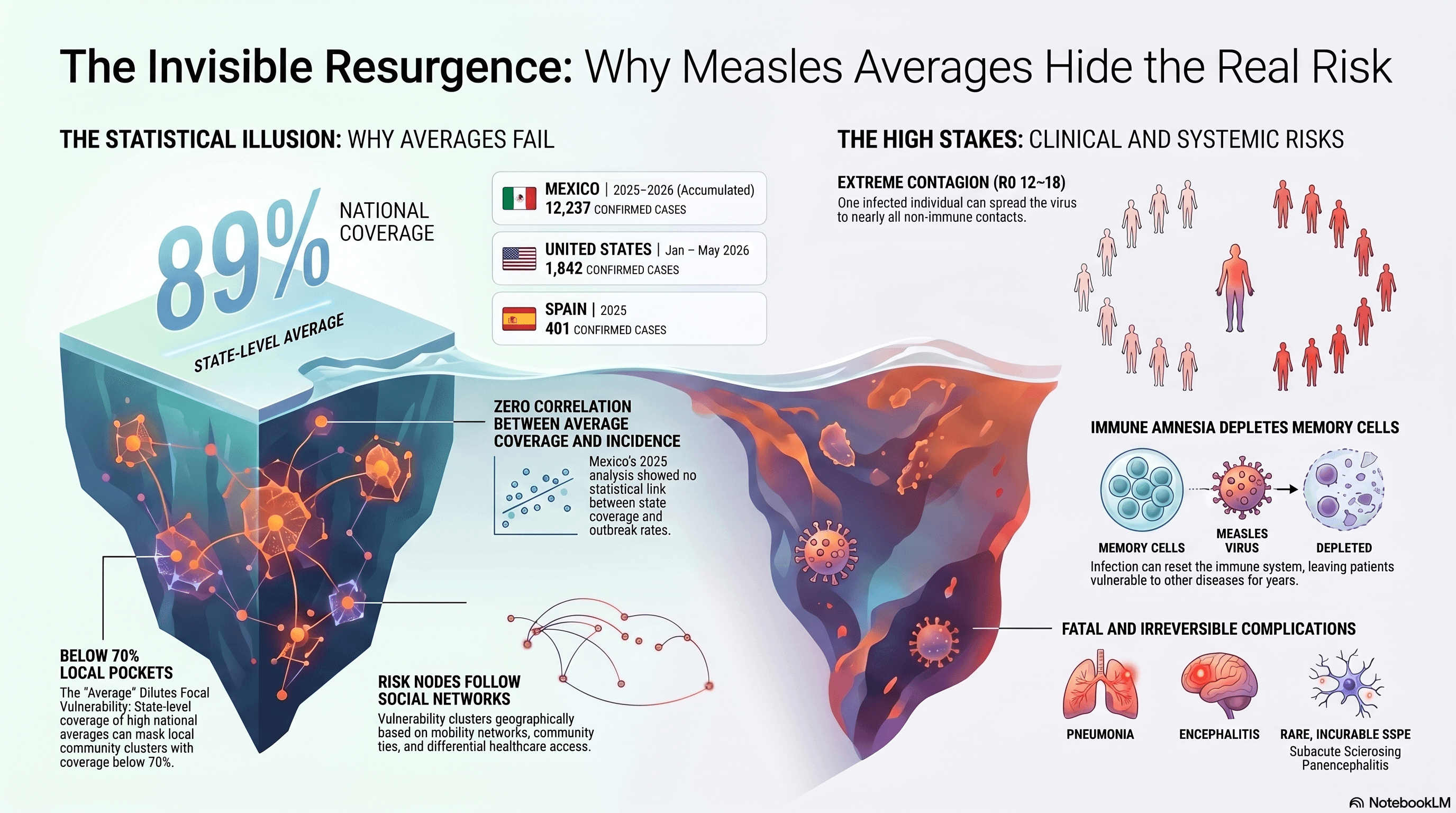
In 2025, Mexico recorded the largest measles outbreak in its recent history: 6,892 confirmed cases distributed across all 32 states. The subsequent epidemiological analysis produced a finding that deserves attention beyond the scale of the outbreak itself: average state-level coverage with the first dose of measles vaccine showed no statistically significant correlation with outbreak incidence rates (Spearman rho = -0.13; p = 0.46). That result is not an argument against vaccination. It is a signal about the metric that surveillance systems use to assess population-level protection, and about what that metric is not measuring.
The question that finding raises is precise: if state or national vaccination coverage does not predict where outbreaks will occur, what is it actually capturing, and what is it leaving outside the field of view of the surveillance system? What the Average Conceals: Actual Susceptibility versus Statistical Coverage
Measles, with an R0 of between 12 and 18, does not require an entire population to be unprotected in order to trigger a sustained outbreak. It needs to find a local cluster of susceptible individuals with sufficient contact density to sustain continuous transmission chains. Those clusters can exist in specific municipalities or communities even when state or national coverage is statistically satisfactory, since aggregate averages dilute the focal vulnerability signal into the statistical noise of the whole. A state-level coverage figure of 89% can coexist without apparent contradiction with specific communities within that same state where actual coverage does not exceed 70% or 75%, below the threshold required to interrupt transmission in a locally exposed population.
What the spatial analysis of the Mexican outbreak documents with unusual precision is that these concentrations of susceptibility are not randomly distributed. They show significant spatial autocorrelation (Moran's I = 0.41 during the first wave), indicating that vulnerability nodes cluster geographically according to mobility networks, community ties, and differential access to vaccination programmes. The outbreak did not originate in the state with the lowest average coverage; it began in Cuauhtémoc, Chihuahua, a municipality with specific sociodemographic characteristics that aggregate state-level coverage indicators had not resolved as an active risk node prior to the event (Martínez-Mateo et al., PMC, 2026).
This phenomenon, which the epidemiological literature sometimes describes as "susceptibility pockets," refers to subnational concentrations of unvaccinated individuals who share geography, social networks, or healthcare systems, and who produce contact densities among susceptibles far greater than what state or national average coverage would suggest. Their invisibility to aggregate monitoring systems is not accidental: it is structural. It results from using a metric of insufficient resolution for the problem it is meant to monitor. The History of Global Coverage: Real Progress with a Structural Fault Line
Between 2000 and 2024, global coverage with the first dose of measles-containing vaccine rose from 71% to 84%, and measles-related deaths fell by 88%, from approximately 777,000 to 95,000 annually. Progress in that period is estimated to have averted around 59 million deaths globally. This is not a system that has failed in absolute terms. It is a system that has reached the limits of what its current monitoring architecture can optimise.
The second dose of the vaccine, critical for closing the immunity gap in individuals who do not seroconvert following the first administration, reached only 76% global coverage in 2024, against a threshold of 95% two-dose coverage required to interrupt measles transmission. Coverage in the Americas, the region that was first to declare measles elimination, stood at 89% for the first dose and 79% for the second in 2024, both below the required threshold (PAHO, February 2026; The Lancet Microbe, January 2026). The gap is not merely a percentage shortfall: it represents a geographical distribution of residual susceptibility that national or regional averages represent as if it were homogeneous, when the evidence from the Mexican outbreak indicates it is anything but.
The pandemic disruption of 2020-2022 did not create this problem from zero. It amplified it and made it more visible. More than 61 million doses of measles-containing vaccine were postponed or missed during that period (Gavi, 2024), and the 24 measles vaccination campaigns in 23 countries that were postponed in 2020 increased the risk of disease for more than 93 million children (The Lancet Microbe, 2022). Those doses were not lost homogeneously: they were lost in a structurally concentrated manner in the same territories that already faced logistical difficulties before the pandemic, where cold chain infrastructure is most fragile, community health worker density is lowest, and geographical access is most irregular. The result was a geographically structured accumulation of unvaccinated birth cohorts that national averages absorbed without generating alert signals, because the magnitude of the gap in those specific territories was diluted into the statistical aggregate of the whole.
Vaccine Hesitancy as an Uncaptured Subnational Variable
In high-income contexts with apparently adequate national coverage, vaccine hesitancy introduces an additional dimension that aggregate monitoring systems manage with increasing difficulty. Hesitancy does not distribute randomly across the population: it tends to concentrate in specific communities with shared social, religious, or cultural characteristics, generating geographically defined clusters of unvaccinated individuals who share high-density contact networks. Those networks produce local transmission conditions equivalent to those of an unvaccinated population, even though the coverage figure of the state or country to which they belong appears statistically within acceptable margins.
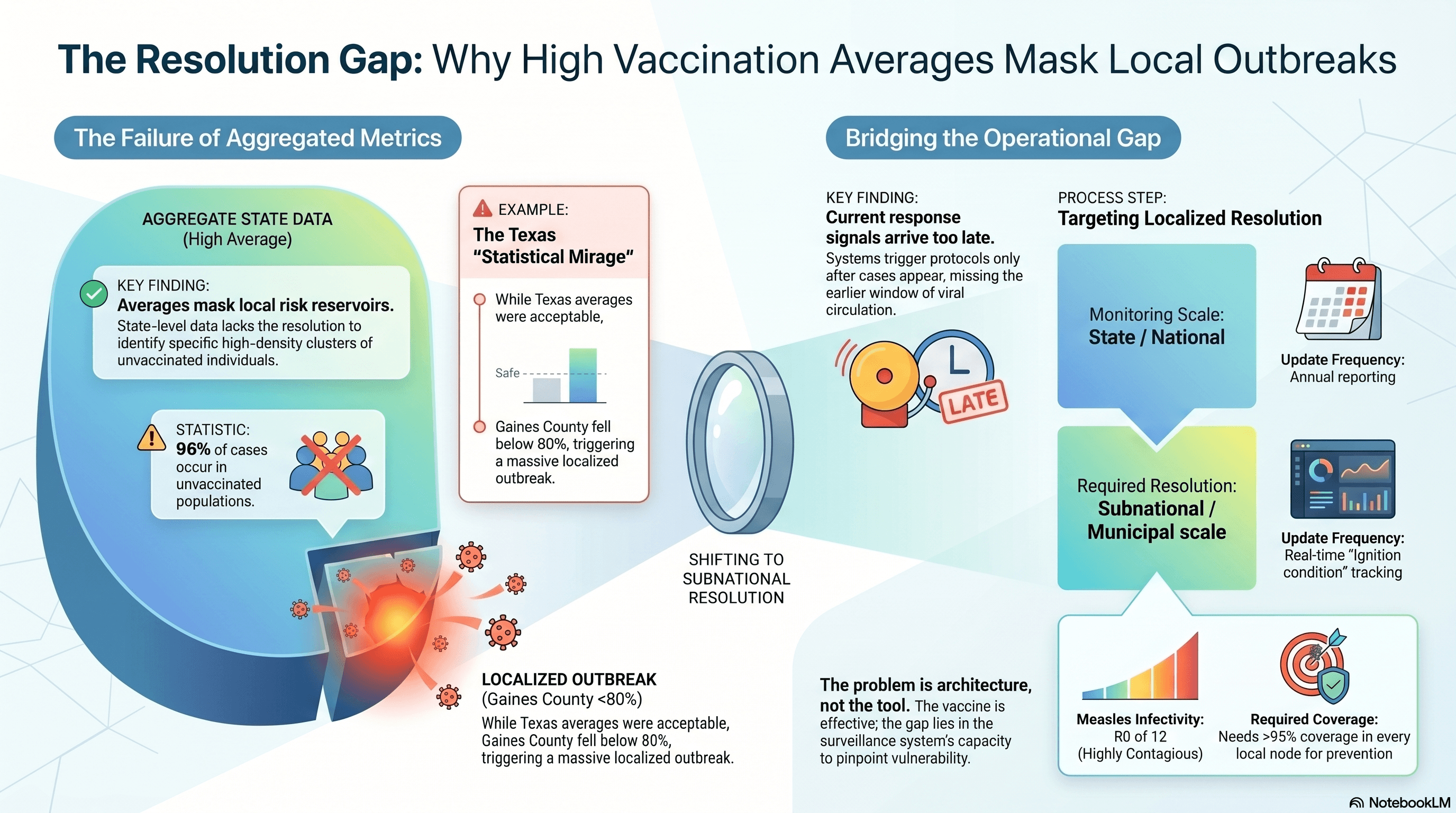
Data from the 2025 North American outbreak illustrate this dynamic clearly. Ninety-six percent of cases in the United States occurred in unvaccinated individuals or those with unknown vaccination status, and the 2025 Texas outbreak originated and amplified in a specific community in Gaines County with local coverage below 80%, while the state-level average coverage for Texas did not indicate differential vulnerability relative to other states (CDC MMWR, 2025). The problem was not Texas as a statistical entity: it was a node of susceptibility within Texas that aggregate monitoring systems lacked the resolution to identify as an active risk reservoir before the first confirmed case triggered response protocols. By that point, the outbreak had already been incubating within that community's contact networks for some time.
This mechanism connects directly with the territorial propagation dynamics documented in the Mexican outbreak and analysed in the preceding article of this series. If susceptibility nodes are invisible to the monitoring system until they generate an active outbreak, the first indicator available to public health authorities is the confirmed case, not the accumulation of susceptibility that preceded it. The signal arrives when the problem has already begun to expand, not when the surveillance architecture could have anticipated it. The Gap Between the Metric and the Response Architecture
The direct operational consequence of using averages as an immunity surveillance metric is that the response system receives a risk signal that is statistically correct but operationally late. State-level coverage of 89% does not trigger preventive intervention protocols. A confirmed active outbreak does trigger them, but by that point the early intervention window has already partially closed, since the pathogen has been circulating through the susceptibility cluster for several replication cycles before the first case reaches the notification system with confirmed diagnosis.
There is an asymmetry here that the current surveillance system is not designed to resolve with available monitoring tools: subnational susceptibility accumulation is a continuous, gradual process that operates over months or years, while the system's response activation threshold is calibrated for the detection of active cases, not for the anticipatory identification of ignition conditions. The result is that immunity surveillance architecture and diagnostic surveillance architecture share the same structural limitation: both generate actionable epidemiological intelligence with a delay relative to the moment when that intelligence would have maximum utility for containment. Resolution, Frequency, and the Problem of the Metric
The operational implication of this analysis is not that vaccination programmes are insufficient, nor that global coverage is an irrelevant indicator. It is that the immunity surveillance system, as currently designed, generates an epidemiological picture whose resolution and update frequency are incompatible with the ignition conditions of measles. Monitoring coverage at state scale with annual frequency allows the description of long-term trends and cross-country comparisons. It does not allow identification of the municipality where a cohort of unvaccinated children is accumulating sufficient contact density to sustain transmission of a pathogen with an R0 of 12, nor does it anticipate the moment at which that cluster will cross the vulnerability threshold that converts viral presence into sustained outbreak.
The design of immunity monitoring architectures capable of operating at the subnational resolution relevant to measles transmission dynamics is therefore a surveillance infrastructure problem before it is a vaccination coverage problem in the strict sense. The vaccine exists, it is effective, and its safety record is solid. The gap is not in the protection tool: it is in the surveillance system's capacity to identify with operational precision where and when that protection is insufficient, before the pathogen finds that answer on its own. References
• Martínez-Mateo, E. et al. "Social Determinants and Outbreak Dynamics of the 2025 Measles Epidemic in Mexico: A Nationwide Analysis of Linked Surveillance Data." PMC, 2026.
• The Lancet Microbe. "Global resurgence in measles." January 2026. doi:10.1016/S2666-5247(26)00002-9
• The Lancet Microbe. "Worrying global decline in measles immunisation." 2022. doi:10.1016/S2666-5247(21)00335-9
• PAHO. "Epidemiological Alert: Measles — Region of the Americas." February 2026. https://www.paho.org • Gavi. "2024 Global Immunisation Coverage Estimates." July 2025. https://www.gavi.org
• CDC. "Measles Update — United States, January 1–April 17, 2025." MMWR, 2025.
• Council on Foreign Relations. "What's Behind the Global Resurgence of Measles?" April 2026. https://www.cfr.org • WHO/UNICEF. "Immunization Coverage Estimates 2024." November 2025. https://www.who.int