Ignacio Calvo
Reading time:
10
min
Transmission Velocity and Confirmation Lag: Measles Propagation Dynamics as a Measure of Structural Surveillance Failure
The 2025-2026 North American measles outbreak quantified the gap between pathogen propagation speed and surveillance response time with unusual precision. The structural implications extend well beyond this specific outbreak.
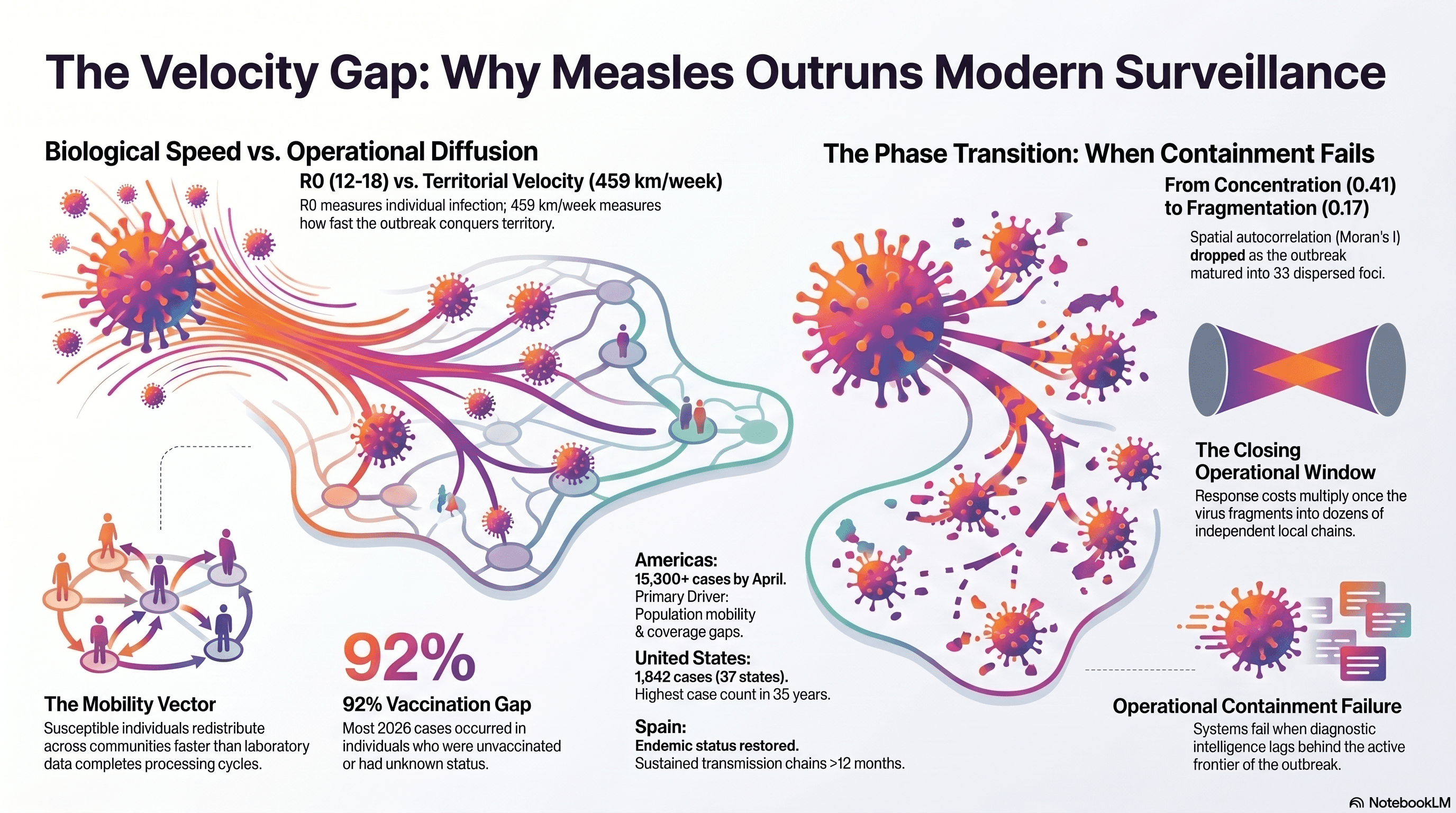
During epidemiological week 47 of 2025, the D8 genotype of the measles virus was travelling approximately 459 kilometres per week through Mexico's population mobility networks, spreading outward from the epicentre in Cuauhtémoc across the national territory. That figure, drawn from the spatial analysis of the 2025-2026 Mexican outbreak, is not a virological data point. It is a geographical and operational one, and that distinction matters. The measles R0, between 12 and 18, describes what the virus does to a susceptible individual; the 459 km/week describes what the outbreak does to a territory before the surveillance system can confirm it, classify it, and activate a coordinated response. The question that number raises is not epidemiological in the classical sense. It is architectural: how many of those kilometres were already covered by active transmission chains at the moment the system generated its first actionable diagnostic intelligence?
The answer to that question does not depend on the biology of the pathogen. It depends on the speed at which the surveillance system can close the interval between clinical suspicion and diagnostic confirmation, and on the geographical resolution with which that confirmation translates into a risk map that can be updated in operationally useful time. When that speed is insufficient relative to the outbreak's rate of expansion, the surveillance system is not failing in its individual analytical components. It is failing as an operational containment infrastructure. Biological Transmission and Operational Diffusion: Two Speeds of the Same Phenomenon
Measles propagation mechanics offer a particularly revealing case study precisely because the variables are known. This is not an emerging pathogen without prior characterisation. The virus, its transmission rate, its airborne dissemination mechanisms, and its dependence on population susceptibility clusters have been documented for decades. What the 2025-2026 North American outbreak adds to the existing body of knowledge is not virological but operational: it quantifies, with unusual precision for field epidemiology literature, the relationship between territorial diffusion speed and the structure of the monitoring systems that were meant to contain it.
The measles R0 is a necessary but insufficient condition for understanding the expansion dynamics of a specific outbreak, since it describes transmission potential in a homogeneously susceptible population, a condition that does not exist in any real territory. What determines the effective speed of territorial expansion is the combination of two vectors: the biological transmission rate of the pathogen, and the mobility rate of the unidentified susceptible population. The first is intrinsic to the virus and cannot be modified during an active outbreak. The second is the vector on which surveillance architecture can act, but only if it generates actionable information with the frequency and geographical resolution required. A mathematical model of the 2025 measles outbreak in northern British Columbia, published in Frontiers in Public Health, demonstrated empirically that inter-community mobility can reduce the impact of interventions during an active outbreak, since susceptible individuals redistribute across communities faster than surveillance systems update their risk maps (Irvine et al., Frontiers in Public Health, 2026, doi:10.3389/fpubh.2026.1794929). The operational conclusion is straightforward: knowing that an outbreak exists is not sufficient; what is needed is knowledge of where its active frontier lies at the present moment, not at the moment laboratory data completed its centralised processing cycle. The Phase Transition as a Closing Operational Window
The analysis of the Mexican outbreak allows for the identification of an epidemic transition with operational implications that most outbreak response models do not incorporate explicitly. During the first wave, the spatial pattern showed highly concentrated clustering, with 46 hot-spot municipalities in Chihuahua and strong spatial autocorrelation (Moran's I = 0.41). In that phase, containment was geographically feasible: the epicentre was identifiable, the risk map was manageable, and response actions — isolation, emergency vaccination, contact tracing — had defined and circumscribed targets. The January 2026 resurgence presented a qualitatively different pattern: 33 foci distributed across multiple states, weakened spatial autocorrelation (I = 0.17), consistent with epidemic maturation from focal introduction toward broader geographical dissemination. In that phase, the operational cost of containment had multiplied because the target had fragmented into dozens of dispersed foci, each with its own local transmission chains and independent expansion dynamics (Martínez-Mateo et al., PMC, 2026).
That inter-phase transition is not merely virological. It is an intervention window that closes, and the speed at which it closes depends directly on the diagnostic confirmation lag.
Confirmation Lag as an Epidemiological Containment Variable
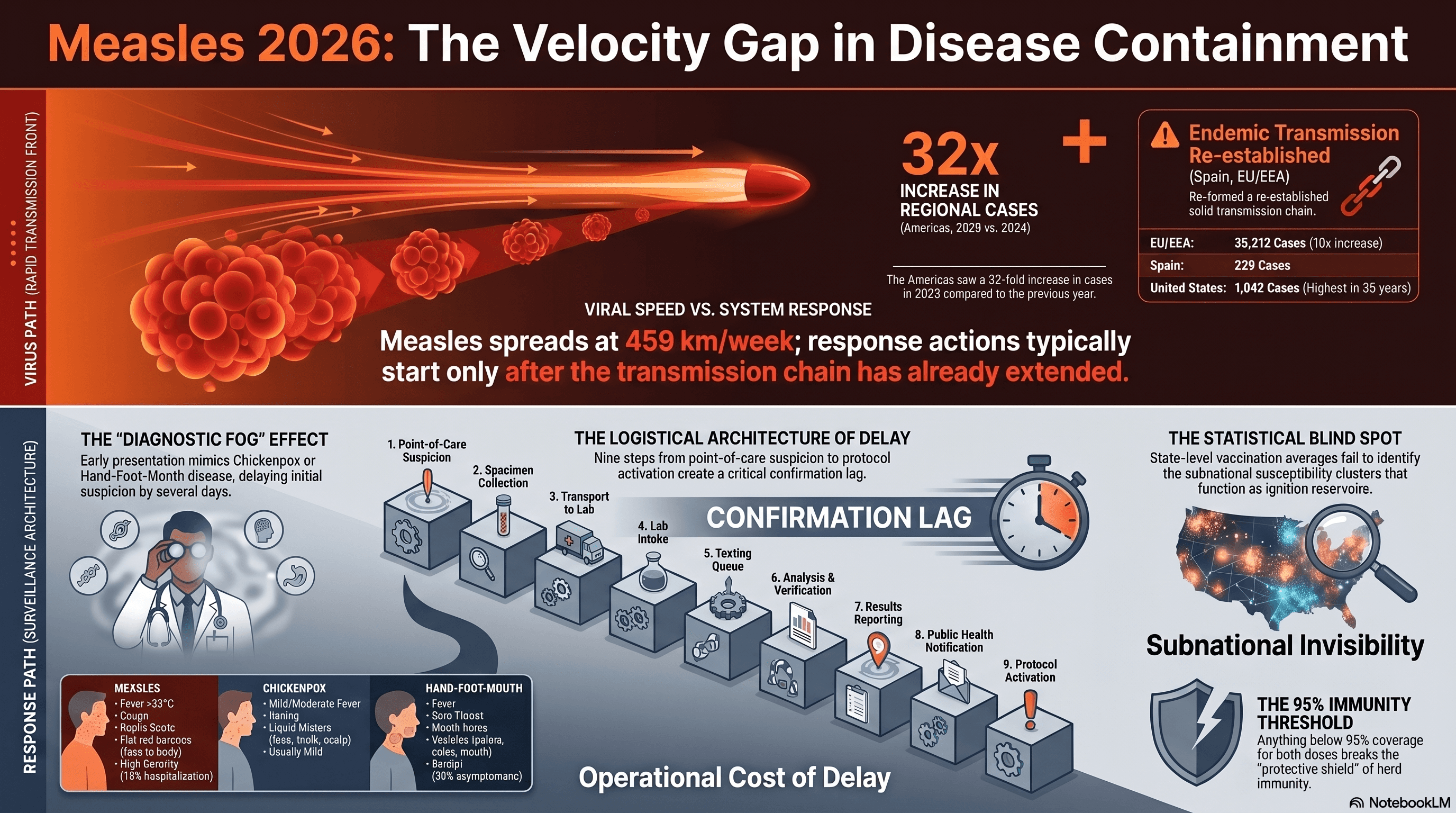
The complete confirmation process for a measles case under the current centralised model includes: clinical suspicion at the point of care, differentiation from other febrile exanthems with similar presentation such as chickenpox or hand-foot-mouth disease, notification to the surveillance system, sample collection, transport to a reference laboratory, serological and molecular analysis, case classification, communication to public health authorities, and activation of the response protocol. Each of those steps carries a minimum execution time that does not depend on the individual efficiency of the operators but on the logistical architecture in which they are embedded. The sum of those times constitutes the confirmation lag, and that lag, applied to a pathogen travelling 459 km/week, determines with reasonable precision how much territory the outbreak has covered before the system can begin to act on it.
The integration of laboratory and epidemiological data for timely case classification is itself a recognised challenge. A comprehensive analysis of virological and epidemiological surveillance during the 2023-2025 measles epidemic in Italy showed that 60.5% of suspected cases were confirmed through laboratory diagnosis, and that 88.1% of those required both serological and molecular methods simultaneously (Gori et al., Diagnostics, 2026, doi:10.3390/diagnostics16071109). That dual-method dependency is not an operational inefficiency; it reflects the genuine complexity of measles confirmation in a post-elimination context where clinical experience with the disease has declined among frontline healthcare workers, many of whom have never managed a measles case during active practice. The New England Journal of Medicine's 2025 review of measles explicitly noted that rapid diagnostic tests could be used routinely as part of global measles surveillance and could improve the timing of outbreak responses — a statement that carries institutional weight precisely because it is not framed as a technological aspiration but as a structural gap in the current surveillance model (Wilder-Smith et al., NEJM, 2025, doi:10.1056/NEJMra2504516). Clinical Diagnostic Confusion and Delayed Initial Suspicion One aspect that field literature tends to treat as a clinical problem but which carries broader operational implications is the difficulty of differential diagnosis at the point of initial suspicion. Measles shares with chickenpox and with Coxsackievirus-caused hand-foot-mouth syndrome an initial presentation of fever and rash that, in the absence of classical pathognomonic signs, can delay specific diagnostic suspicion by several days. That delay in suspicion precedes the delay in confirmation, meaning the real operational lag between the first infectious case in a transmission chain and the first coordinated response action is systematically greater than what notification records reflect. Data from the 2025 North American outbreak show that 96% of cases in the United States occurred in unvaccinated individuals or those with unknown vaccination status, and that 13% required hospitalisation (CDC Measles Update, MMWR, 2025). Clinical severity was not functioning as an early warning signal: hospitalisations are the consequence of an already established infection, not an anticipatory indicator of an advancing active transmission front. By the time severity data enters the notification system, the transmission chain generating those cases has already extended considerably beyond the confirmed cases it produced. Aggregated Vaccination Coverage and Subnational Invisibility of Risk The analysis of vaccination coverage as a predictive variable for outbreak risk adds a further layer to the argument. Data from the Mexican outbreak show that average state-level coverage with the first dose of measles vaccine did not correlate with outbreak incidence rates (Spearman rho = -0.13; p = 0.46). That result does not indicate that vaccination is irrelevant; it indicates that statistical averages at state or national scale lack the resolution to identify the subnational susceptibility clusters that function as ignition reservoirs. The virus does not operate on average populations: it operates on nodes of actual susceptibility. The outbreak's spatial diffusion speed of 194.8 km/week at state level, rising to 459 km/week at municipal level through population mobility networks, reflects the practical consequence of that mismatch: the monitoring architecture generates a picture that is statistically accurate at the aggregate level and operationally blind at the granularity that matters for containment. When coverage monitoring systems work with aggregates that conceal those nodes, the epidemiological picture available to response managers is structurally incomplete, regardless of its formal statistical accuracy. Surveillance Architecture and the Operational Cost of Delay The operational implication that emerges from this analysis is the following: when the propagation speed of a well-characterised pathogen, with an effective vaccine and response protocols established for decades, consistently outpaces the speed at which the surveillance system generates actionable diagnostic intelligence, the problem does not reside in the available analytical tools. It resides in the architecture that determines when and where those tools produce their output, and with what geographical resolution that output is incorporated into epidemiological decision flows. The Cuauhtémoc outbreak, in its first phase, was a containable event. The transition to the second phase, with 33 foci across multiple states, was the cumulative result of multiple replication cycles that advanced during the interval between the first active transmission and the first diagnostic confirmation that triggered coordinated response. Quantifying that interval with operational precision, and designing surveillance architectures capable of systematically reducing it, is the structural problem that the 2025-2026 measles outbreak has documented with unusual clarity. References • Irvine, M.A. et al. "Mobility between communities can reduce the impact of measles intervention during an outbreak: a mathematical modeling study." Frontiers in Public Health, 2026. doi:10.3389/fpubh.2026.1794929 • Martínez-Mateo, E. et al. "Social Determinants and Outbreak Dynamics of the 2025 Measles Epidemic in Mexico: A Nationwide Analysis of Linked Surveillance Data." PMC, 2026. • Gori, M. et al. "A Comprehensive Analysis of Diagnostic and Virological Surveillance During the 2023-2025 Measles Epidemic Scenario." Diagnostics, 2026. doi:10.3390/diagnostics16071109 • Wilder-Smith, A. et al. "Measles 2025." New England Journal of Medicine, 2025. doi:10.1056/NEJMra2504516 • CDC. "Measles Update — United States, January 1–April 17, 2025." MMWR, 2025. • PAHO. "Epidemiological Alert: Measles — Region of the Americas." February 4, 2026. https://www.paho.org • WHO/UNICEF. "Measles and Rubella Global Strategic Plan 2021-2030." WHO, 2025. https://www.who.int