Ignacio Calvo
Reading time:
10
min
Diagnostic Silence and Measles Resurgence: Confirmation Architecture as a Determinant of Containment Failure
The 2025-2026 measles outbreak was not a failure of available diagnostic tools. It was a failure of the architecture that determines when and where those tools generate their signal.
Measles is one of the best-characterised pathogens in the history of medicine. Its virology, transmission rate, airborne dissemination mechanisms, clinical presentation, and complications have been documented for decades at a level of detail that few infectious diseases can match. The vaccine has existed since 1963, its efficacy exceeds 97% with two doses, and outbreak response protocols are established and standardised across international public health practice. And yet, in 2025 and 2026, measles produced the largest outbreaks in decades across North America, Europe, and Asia, with more than 552,000 suspected cases notified across 179 countries in 2025 alone, 45% of which were confirmed. That paradox is not resolved solely by arguments about insufficient vaccination coverage. It requires examining what happens between the moment the virus begins to circulate and the moment the surveillance system can activate a coordinated response, and how much epidemiological ground is lost in that interval.
The period during which a pathogen circulates without effective actionable diagnostic confirmation is not an operational accident nor a correctable deficiency attributable to individual professional inefficiency. It is a product of the surveillance system's architecture: of where the point of diagnostic intelligence generation is located, of how many intermediate steps separate suspicion from confirmation, and of how quickly that confirmation translates into actionable information for the epidemiological response. That interval is the Diagnostic Silence, and its duration during the 2025-2026 North American outbreak had documented and quantifiable epidemiological consequences. Clinical Differential Confusion as the First Link in the Silence
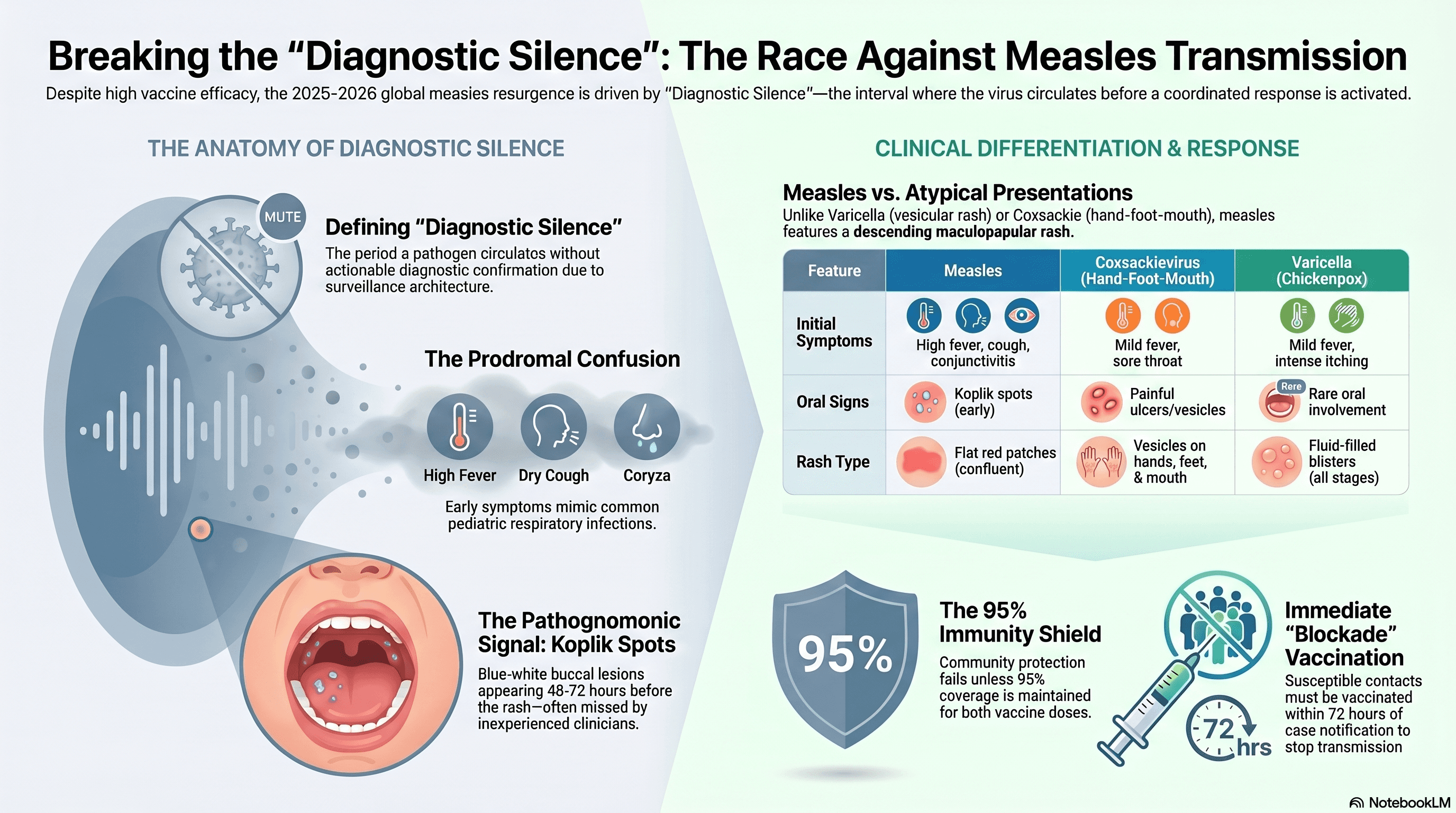
Measles in its prodromal phase, the three to five days preceding the appearance of the characteristic rash, presents with a triad of high fever, dry cough, and coryza that it shares with multiple common respiratory infections of high prevalence in the paediatric population. In emergency settings or high-pressure primary care, that initial picture does not generate specific measles suspicion with the frequency that early activation of isolation and notification protocols would require. The subsequent appearance of the maculopapular, confluent rash, beginning on the face and descending to the trunk and extremities, reduces clinical ambiguity but does not eliminate it: chickenpox produces vesicular rash with centripetal distribution and intense pruritus that distinguishes it from measles with clinical experience, but hand-foot-mouth syndrome caused by Coxsackievirus can generate, in its atypical presentations, febrile rash pictures that in real clinical practice, particularly for professionals who have never managed a measles case, produce operationally relevant differential confusion.
Koplik spots, the blue-white lesions on the buccal mucosa that are pathognomonic of measles, appear in a 48 to 72-hour window before the rash and disappear rapidly once the rash begins, meaning their clinical utility as an early suspicion signal depends on the clinician actively searching for them and knowing how to identify them. In the current context, that clinical knowledge is unevenly distributed. The NEJM documented in its 2025 review that many of the healthcare professionals convened at the US Measles Summit had never treated a case of the disease, since measles elimination in 2000 created a generational gap in direct clinical experience that the training system has not compensated for systematically (Wilder-Smith et al., NEJM, 2025). The loss of clinical familiarity with measles is a direct consequence of the prior success of vaccination, and it constitutes a negative feedback mechanism that the surveillance system does not quantify because the delay in suspicion is not registered as a notifiable event.
That delay in suspicion is the first and least visible link in the Diagnostic Silence. The time that elapses between the first clinical contact with an infectious case and the formulation of a specific measles diagnostic suspicion leaves no trace in epidemiological notification systems, but it determines how many secondary contacts have occurred before any response protocol is activated. A measles case in the prodromal phase that attends an emergency department, is assessed as a common respiratory infection, and returns to their community without isolation or notification, will have been in contact with other patients in the waiting area, with the clinical staff who assessed them, and with their domestic and social environment in the subsequent days, all of them potentially susceptible. That interval of circulation without operational visibility is Diagnostic Silence in its most elementary form. The Centralised Confirmation Process and Its Temporal Cost
Once a specific measles diagnostic suspicion is formulated, the confirmation process under the current centralised model introduces a second set of structural delays that accumulate on top of the initial suspicion lag. The evidence that confirmation is neither immediate nor straightforward comes from laboratory practice itself, as documented during the recent epidemic cycle. The comprehensive analysis of virological and epidemiological surveillance during the 2023-2025 measles epidemic scenario in Italy showed that 60.5% of suspected cases were confirmed through laboratory diagnosis, and that 88.1% of those confirmed cases required the simultaneous application of both serological and molecular methods (Gori et al., Diagnostics, 2026, doi:10.3390/diagnostics16071109). That dual-method dependency is not a correctable inefficiency through greater automation of the reference laboratory: it is a genuine diagnostic necessity derived from the characteristics of the immune response to measles and from the complexity of interpreting individual results in a low-prevalence context with a partially vaccinated population.
Serology detects specific IgM antibodies against measles, but in the very early phase of infection, before the fifth day of rash onset, the antibody response may be insufficient to produce a positive result, since what appears as a false negative is not an assay error but the biology of seroconversion. Real-time PCR on nasopharyngeal swab or urine samples detects viral RNA directly, with greater sensitivity in the first days of rash, but does not unambiguously distinguish between wild-type infection and post-vaccination viral shedding in certain clinical contexts. The combination of both methodologies in the reference laboratory is therefore clinically justified practice, and its cost is temporal: it requires processing in facilities with dual analytical capacity, with all the logistical steps that entails within a centralised system framework.
The operational result is an interval between sample collection and definitive case classification that, added to the prior suspicion lag, determines total Diagnostic Silence. In the optimal scenario, with a nearby reference laboratory, adequate sample quality, available processing capacity, and concordant results between both methods, that interval may be two or three days. In real scenarios during an active outbreak, with reference laboratory saturation, samples collected under suboptimal conditions, or discordant serological and molecular results requiring additional analysis, that interval extends. And each day of extension has a multiplicative cost on the potential size of the outbreak proportional to the pathogen's R0 and the size of the exposed susceptibility cluster.
Diagnostic Silence as a Measurable Epidemiological Variable
Diagnostic Silence is not an operational metaphor. It is the quantifiable interval between the moment an infectious individual begins generating secondary contacts and the moment the surveillance system has actionable diagnostic confirmation of that case. During that interval, the pathogen circulates with full transmission capacity and without operational visibility for the response system, since no event exists in the notification records that would trigger isolation protocols, contact tracing, or emergency vaccination. The outbreak exists biologically but does not exist epidemiologically for the system.
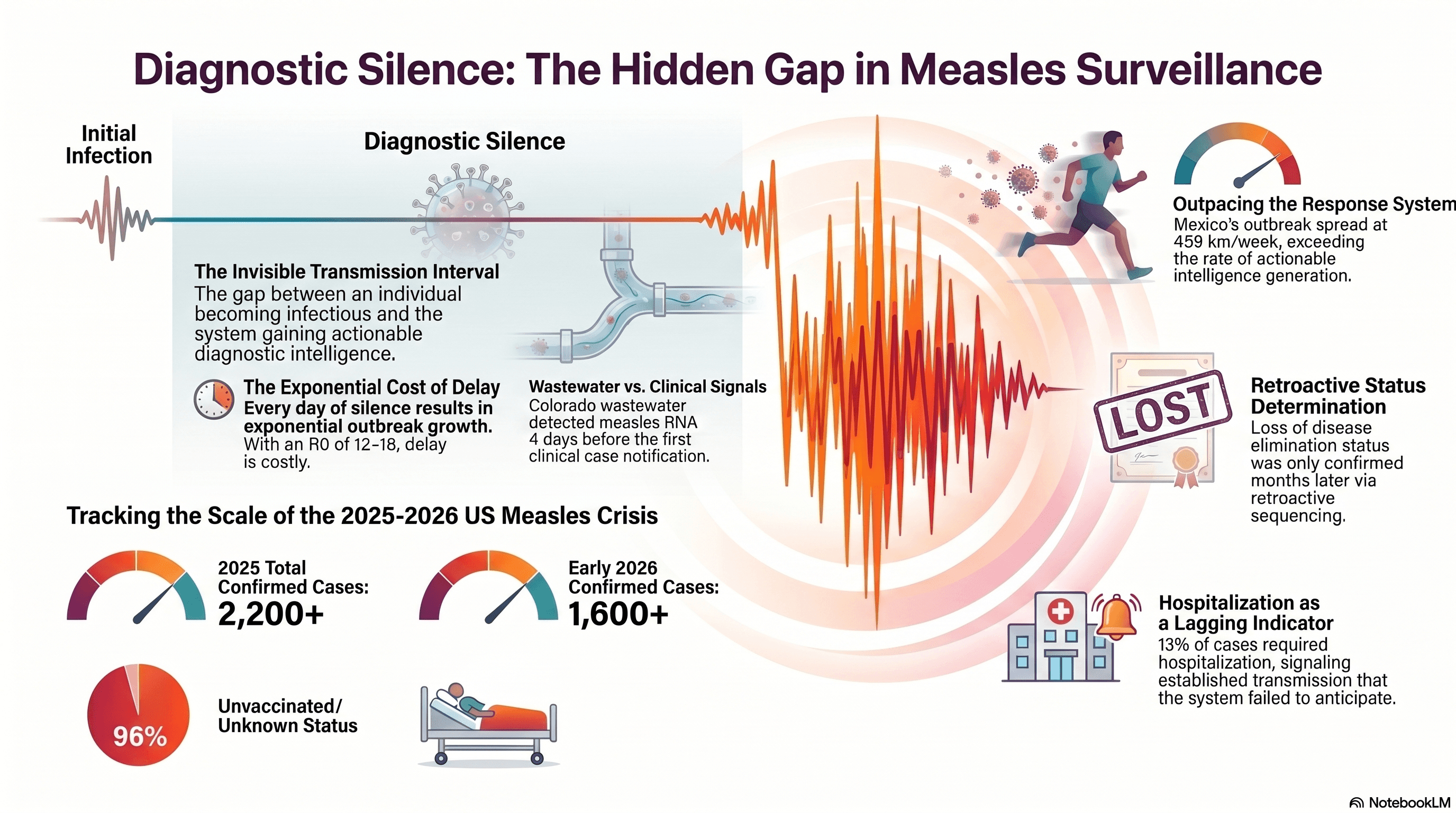
The relevance of that interval depends critically on the pathogen's transmission rate. For measles, with documented capacity to generate between 14 and 18 secondary cases per index case in a susceptible population, each day of Diagnostic Silence carries a multiplicative cost on the potential outbreak size that is not linear but exponential in the initial phases of expansion. The analysis of the Mexican outbreak, discussed in the first article of this series, documented that the transition from concentrated focal clustering (Moran's I = 0.41, 46 hot-spot municipalities in Chihuahua) to dispersed geographic dissemination (I = 0.17, 33 foci across multiple states) occurred during the period when the surveillance system was still accumulating confirmations and characterising the first wave. The second wave did not wait for the first to be fully characterised, since the outbreak's territorial propagation speed, approximately 459 km/week, exceeded the rate at which the system was generating actionable diagnostic intelligence about its active frontier.
The most direct evidence that Diagnostic Silence is an architectural limit and not a biological one comes from wastewater surveillance. Colorado's programme detected measles virus RNA in wastewater from Mesa County in August 2025, four days before the first clinical cases were notified among residents served by that same treatment plant (CDC MMWR, 2025). The molecular signal was available before the clinical signal because the point of diagnostic intelligence generation was closer to the original epidemiological event: the environmental surveillance system does not depend on an infectious individual attending a healthcare centre, being assessed by a clinician with specific suspicion, and completing the laboratory confirmation circuit. That four-day anticipation, in a pathogen with an R0 of between 12 and 18, is not a marginal data point. Systemic Consequences: What the 2025 Outbreak Documents
The 2025-2026 North American outbreak provides empirical evidence of the systemic consequences of Diagnostic Silence accumulated at outbreak scale, beyond the individual case level. The United States reached in 2025 its highest confirmed case count since 1992, exceeding 2,200, and by the first months of 2026 had accumulated more than 1,600 additional cases. Thirteen percent of cases required hospitalisation, and 96% occurred in unvaccinated individuals or those with unknown vaccination status (CDC MMWR, 2025). Hospitalisations are not early warning signals: they are indicators of already established infections in individuals who have already generated secondary contacts. The system was responding to consequences, not anticipating transmission.
The most illustrative dimension of Diagnostic Silence at systemic scale in this outbreak was the surveillance system's inability to determine in real time whether the United States was experiencing the 12 months of uninterrupted transmission that constitute the threshold for loss of elimination status, certified in the year 2000. The determination of that epidemiological status depended on the retroactive sequencing of approximately 1,000 samples from the 2025-2026 outbreak by researchers at the Broad Institute, under federal contract, with data beginning to be submitted to the CDC in December 2025 (Becker's Hospital Review, April 2026). The molecular intelligence that would have allowed characterisation of transmission chains in real time during the outbreak was generated months after the event, when the regulatory decision on elimination status was already imminent. That is Diagnostic Silence operating not at the level of the individual case but at the level of the national surveillance system: molecular confirmation of what had happened arrived when it could no longer influence the response to the event it described. The Question the Outbreak Leaves Open
Diagnostic Silence in the 2025-2026 measles outbreak was not the result of insufficient diagnostic tools. PCR techniques, high-sensitivity serology, and genomic sequencing exist and are effective. It was the result of a surveillance architecture that positions the point of diagnostic intelligence generation at the centralised reference laboratory, at the end of a multi-step logistical chain, with an activation threshold conditioned on the clinical professional first formulating the correct suspicion. In a context where the majority of active healthcare professionals have never treated a measles case, that threshold introduces a systematic delay that is not exceptional but structural.
The question the outbreak documents with unusual clarity is how much of the epidemiological damage produced during the silence intervals was structurally avoidable, and what type of diagnostic surveillance architecture, with what point of signal generation and what speed of translation of that signal into actionable intelligence, would have needed to be operational in Cuauhtémoc in the week before the first confirmed case to alter the course of the outbreak that followed. References
• Wilder-Smith, A. et al. "Measles 2025." New England Journal of Medicine, 2025. doi:10.1056/NEJMra2504516
• Gori, M. et al. "A Comprehensive Analysis of Diagnostic and Virological Surveillance During the 2023-2025 Measles Epidemic Scenario." Diagnostics, 2026. doi:10.3390/diagnostics16071109
• CDC/NCIRD. "Notes from the Field: Wastewater Surveillance for Measles Virus During a Measles Outbreak — Colorado, August 2025." MMWR, 2025.
• CDC. "Measles Update — United States, January 1–April 17, 2025." MMWR, 2025.
• Becker's Hospital Review. "New CDC measles data could signal end of US elimination status." April 2026.
• PAHO. "Epidemiological Alert: Measles — Region of the Americas." February 2026. https://www.paho.org • WHO. Global Measles and Rubella Report. November 2025. https://www.who.int
• Martínez-Mateo, E. et al. "Social Determinants and Outbreak Dynamics of the 2025 Measles Epidemic in Mexico." PMC, 2026.