Ignacio Calvo
Reading time:
10
min
Hantavirus and the Point-of-Need Imperative: Distributed Molecular Surveillance in Ecologically Active Zones
The MV Hondius outbreak revealed a structural gap: diagnostic capacity existed, but not where it mattered. An analysis of distributed molecular surveillance for interface zoonoses.
The Distinction the MV Hondius Makes Visible
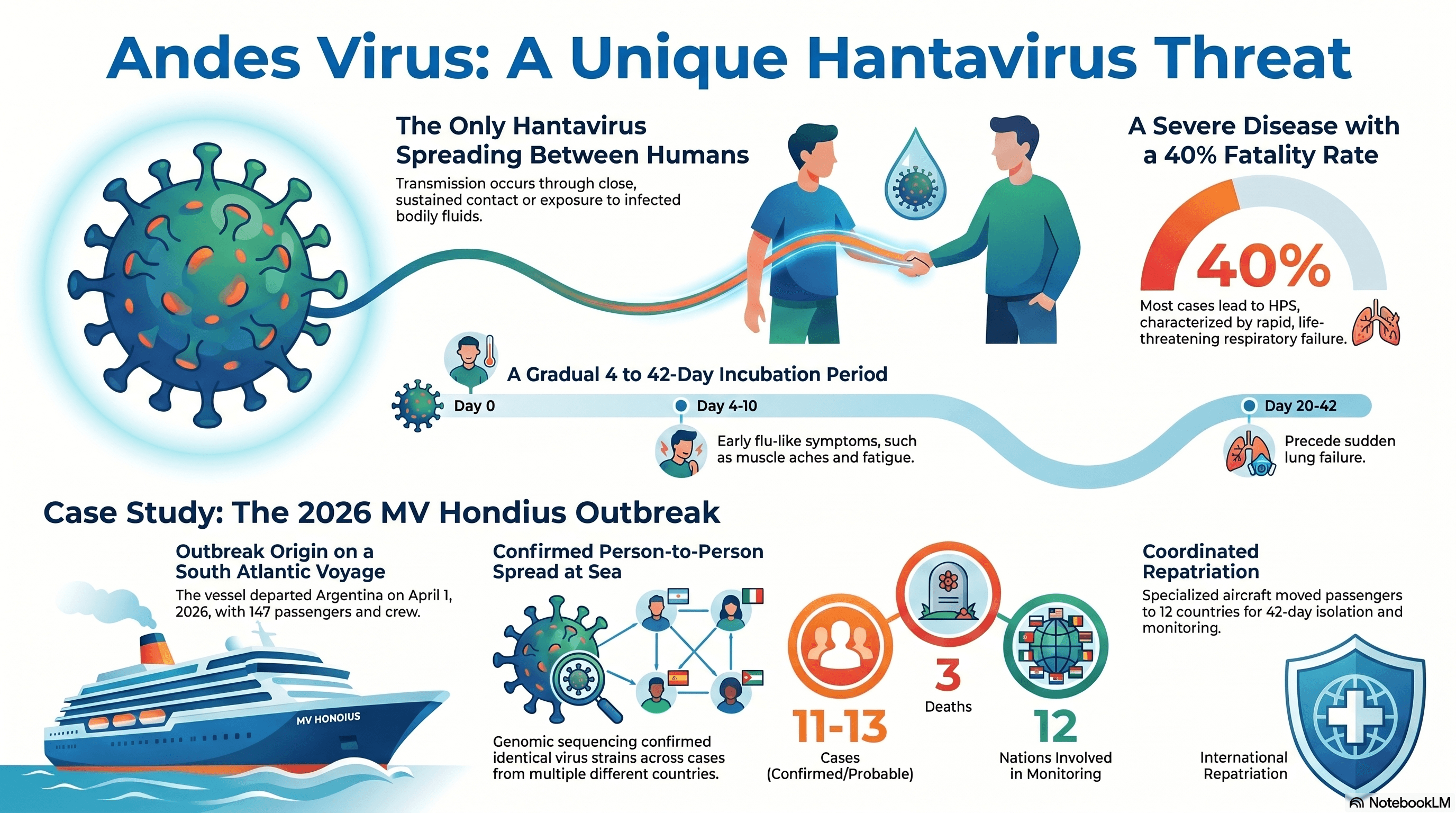
The MV Hondius outbreak did not occur because the Andes virus was undetectable. It occurred, in its most operationally relevant dimension, because the capacity to detect it was not available where and when it would have had containment value. That distinction — between diagnostic capacity that exists within the system and diagnostic capacity that is operationally accessible at the point of risk — is less obvious than it appears, and its implications for epidemiological surveillance architecture are considerably more profound than those generated by most post-outbreak analyses.
Argentina has reference laboratories with accumulated expertise in Andes virus diagnosis. The Netherlands, the United Kingdom, and Switzerland have high-level containment infrastructure. The WHO was able to coordinate the shipment of reagents and diagnostic kits from Buenos Aires to five countries within days, demonstrating that the technical knowledge and materials existed. What did not exist was that capacity aboard the MV Hondius when the first passenger began showing symptoms on 6 April, nor at the ports of call where contacts disembarked without diagnostic information, nor at the airports from which they boarded intercontinental flights toward a dozen countries.
Modern epidemiological surveillance operates, for the most part, under a model that might be described as centralised confirmation with distributed response: the diagnostic signal is generated in reference laboratories, and from there response protocols are activated at the periphery. That model functions reasonably well when the time between exposure and confirmation is compatible with the speed at which contacts disperse. In the case of hantavirus in high international mobility environments, that compatibility does not exist. The index case of the MV Hondius took 21 days to receive post-mortem molecular confirmation, as the first death occurred on 11 April and confirmation arrived on 2 May. During that interval, the centralised confirmation model produced exactly what its architecture predicts: a perfectly coordinated and perfectly late response.
It is worth defining the terms precisely. What the centralised model produces is confirmation diagnosis: the rigorous determination, with full analytical validation, of which agent is causing the observed clinical presentation. What the MV Hondius scenario required, and did not have, is something operationally distinct: containment diagnosis — the capacity to generate a diagnostic signal that is early enough and reliable enough at the point of risk to activate isolation, tracing, and containment protocols before the operational window closes. Those two functions are not equivalent, do not necessarily require the same tools, and the confusion between them is, in part, responsible for surveillance systems continuing to be designed around the first objective without structurally addressing the second.
Hantavirus as an Interface Pathogen: Why Ecology Defines Surveillance Architecture The Andes virus does not circulate in hospitals. It does not circulate in airports, cruise ships, or cities. It circulates in rodents of the genus Oligoryzomys — the long-tailed rice rat — in specific ecosystems of the Southern Cone: the Patagonian steppe, the Andean valleys, the rural and peri-urban zones of southern Chile and Argentina, the margins of rivers and lakes in regions of low population density. Humans become infected at the interface with that ecosystem, either through exposure to aerosols from excreta of infected rodents during agricultural, forestry, or hiking activities, or, in the specific case of the Andes virus, through close contact with a previous human case who acquired the infection through that same original zoonotic route.
That geography of risk is structurally incompatible with a surveillance model that requires transferring samples to reference laboratories to generate the first diagnostic signal. Not because the laboratories are inefficient — in the context of the MV Hondius they responded with remarkable speed once activated — but because the point where the epidemiological event occurs and the point where the system can confirm it are separated by thousands of kilometres and by a logistical chain that consumes, at best, days. And in the hantavirus scenario, the clinically relevant window for intervention is measured in precisely those days.
The distribution of endemic cases across the Southern Cone illustrates the scale of the problem. In 2025, PAHO recorded 229 confirmed cases and 59 deaths in eight countries, with the vast majority concentrated in rural zones of Argentina, Chile, Bolivia, and Brazil. Between 2025 and 2026, Argentina reported 86 cases and 28 deaths with a case fatality rate of 33.6%, documenting in addition a geographical expansion toward historically non-endemic zones: the Paraná delta, Samborombón Bay, the metropolitan area of Buenos Aires. That expansion does not reflect a change in the biology of the virus, but in the distribution of the reservoir, as Oligoryzomys populations respond to ecological variables — food availability, temperature, precipitation — that climate change is altering in a documented manner. The risk map moves. The diagnostic infrastructure does not. In this context, the concept of an ecologically active zone offers a more precise operational unit than the geopolitical categories conventionally used in health surveillance. An ecologically active zone for hantavirus is one where the population density of infected Oligoryzomys exceeds documented thresholds of spillover risk, where human activity generates regular exposure to the interface with the reservoir, and where the probability that an exposed person will develop symptoms before accessing a health system with specific diagnostic capacity is high. That definition does not map perfectly onto national borders or existing health infrastructure maps. It maps onto ecosystems, onto rodent migration routes, onto seasonal patterns of human activity in rural areas.
What makes hantavirus a paradigmatic case for this analysis — and not simply another pathogen on a list of zoonotic threats — is the combination of three characteristics that rarely present together with this degree of clarity. First: its point of risk is geographically predictable, as the distribution of the reservoir is reasonably well documented. Second: its diagnostic window is narrow, given that RT-PCR-detectable viraemia is limited to approximately the first seven to ten days after symptom onset, meaning the sample has molecular value only if obtained and processed rapidly. Third: its mortality without early intervention is among the highest of emerging zoonotic pathogens, with rates in cardiopulmonary syndrome reaching 30 to 40%. Those three characteristics together define a pathogen where the operational value of diagnosis decays non-linearly with time. A diagnosis on day two has a radically different containment value from a diagnosis on day twenty-one. And the architecture of the system determines which of the two is structurally possible.
One Health surveillance, in its most operational formulation, recognises precisely this problem: that effective detection of emerging zoonoses cannot operate exclusively at the human level, since by the time the health system identifies the human case, the ecological cycle that originated it has been active for weeks or months. The One Health operational frameworks published in recent years — including the generalizable framework for zoonotic disease control documented in Scientific Reports (2022) and the WHO guidelines for vector-borne and zoonotic disease surveillance — converge on the view that distributed diagnostic capacity at the human-animal interface is a necessary, not optional, condition of any surveillance system capable of operating ahead of the epidemiological event rather than behind it. Hantavirus in the ecologically active zones of the Southern Cone is, in that sense, a case study with all variables well defined and a documented history of what happens when that capacity does not exist.
Current State of Portable Molecular Diagnostics for Hantavirus: What the Evidence Establishes
The perception that hantavirus lacks diagnostic tools usable outside reference laboratories is, in part, a simplification that the MV Hondius outbreak contributed to consolidating in the media coverage of the event. The technical reality is more nuanced, and that nuance has direct operational implications for the argument this article develops.
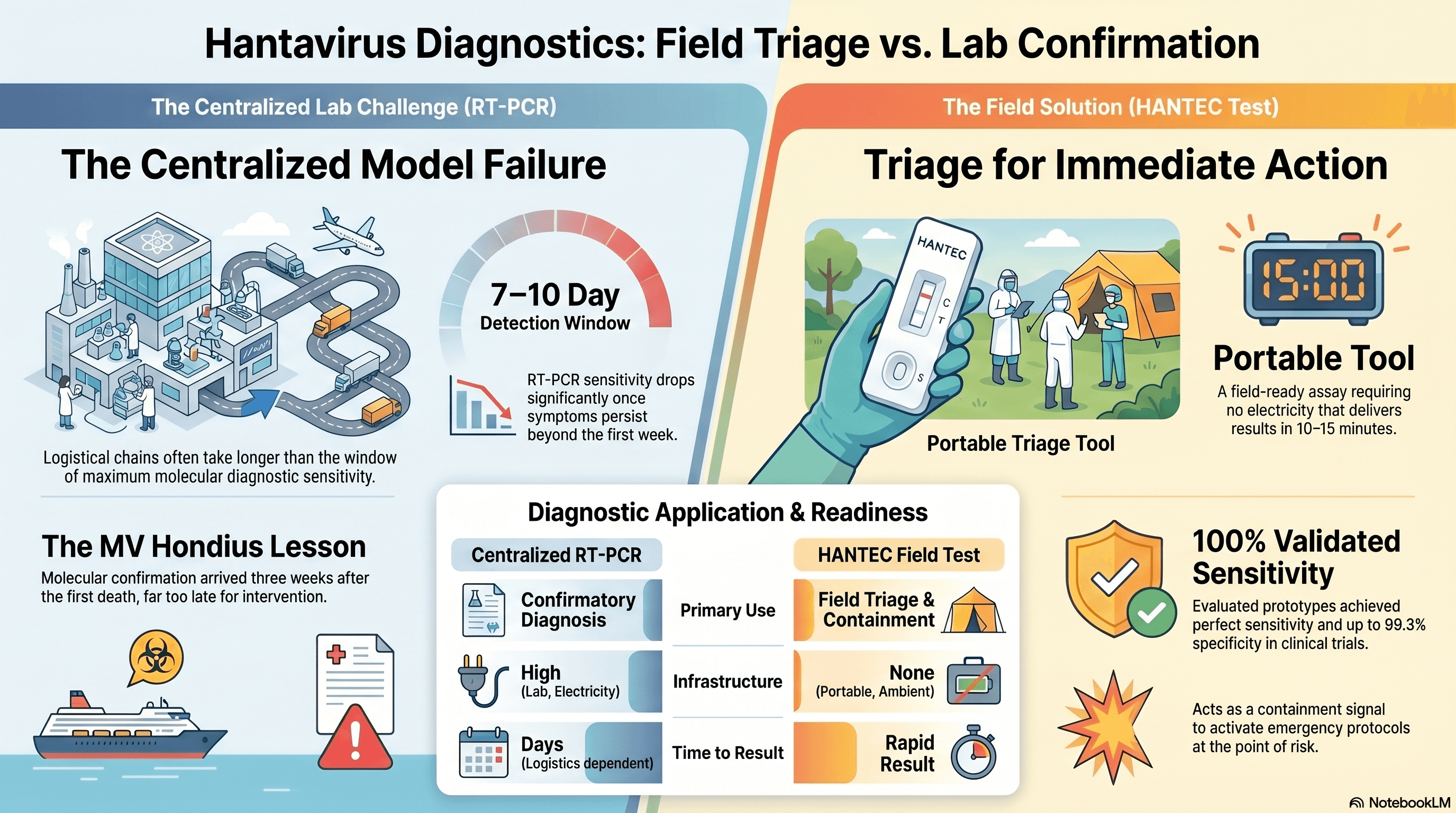
In 2024, a research team published in Diagnostic Microbiology and Infectious Disease the validation of the HANTEC test, a lateral flow immunochromatographic assay designed specifically for the detection of hantavirus antibodies under field conditions. The test detects IgM, IgG, or both against South American strains including the Andes virus, requires no equipment or electricity, generates a result within ten to fifteen minutes, and can be stored and operated under variable ambient conditions. In the published validation, the evaluated prototypes achieved 100% sensitivity and specificity between 97.5% and 99.3% across a sample of 163 cases, including confirmed hantavirus patients, patients with related diseases, and healthy controls. The authors also documented its potential utility for epidemiological surveys and active surveillance in endemic zones, beyond individual clinical diagnosis.
That result is operationally relevant for what it establishes and for what it does not establish. It establishes that published scientific evidence exists demonstrating that serological detection of hantavirus under field conditions is technically achievable with portable tools, without laboratory infrastructure, in timeframes compatible with immediate clinical and epidemiological decision-making. It does not establish that this tool is equivalent to confirmatory RT-PCR in terms of diagnostic specificity during the early viraemic phase, nor that its availability alone resolves the structural limitation described in the preceding sections. The distinction between a triage tool and a confirmation tool, introduced at the outset of this analysis, operates here with precision: the HANTEC test has the profile of a containment diagnosis tool — capable of generating a grounded suspicion signal at the point of risk that activates the response protocol — not of a confirmation diagnosis in the sense of reference laboratories.
The contrast with the current state of Andes virus-specific RT-PCR diagnosis is revealing. The interim guidance issued by the CDC in May 2026 in response to the MV Hondius outbreak documents that at that time no CLIA-validated rRT-PCR assay specific to the Andes virus existed in the United States outside the Nebraska Public Health Laboratory. For serological assays detecting antibodies against New World hantaviruses, capacity was available at the CDC, at some state public health laboratories, and at Quest Diagnostics. The guidance also adds a technical precision with direct operational implications: RT-PCR sensitivity decreases significantly for samples obtained beyond seven to ten days after symptom onset, as viraemia may be low or undetectable beyond that point. In the case of the MV Hondius, molecular confirmation arrived three weeks after the first death. The window of maximum molecular diagnostic sensitivity had closed long before the system generated its first confirmatory signal.
That data point is not a minor technical detail. It is the precise description of why the centralised model fails specifically for hantavirus: the agent has a narrow viraemic window that makes RT-PCR most useful the earlier it is applied, but the logistical chain connecting the point of risk to the reference laboratory consumes precisely the days during which that tool has the greatest diagnostic value. Serology — more temporally robust, but with limitations in the very early phase before seroconversion — can complement that deficit, but cannot eliminate it without a diagnostic presence closer to the initial clinical event.
Comparison with pathogens where diagnostic decentralisation is more developed allows calibration of where hantavirus sits within the landscape of available tools. For tuberculosis, the WHO recommends and has extensively validated the GeneXpert system, a cartridge-based molecular diagnostic platform that operates in low-infrastructure environments with sensitivity equivalent to the culture standard. For HIV, internationally validated POC platforms have transformed diagnostic and monitoring capacity in resource-limited settings. For Mpox, the WHO strategic framework 2024-2027 explicitly establishes the development of diagnostic tools for decentralised sites and point-of-care as a structural requirement of the control strategy. Hantavirus does not feature in any of those frameworks with the same level of prioritisation, reflecting its epidemiological profile: high regional mortality, but low global frequency in absolute terms, which reduces its presence in the diagnostic development agendas of major international funders.
That asymmetry between regional epidemiological burden — 33.6% case fatality rate in the Southern Cone, 86 cases and 28 deaths in the 2025-2026 cycle — and investment in specific decentralised diagnostic tools is not a market anomaly. It is the predictable consequence of a prioritisation system that tends to respond to the international visibility of outbreaks rather than to the documented burden in populations with less capacity to generate pressure on those agendas. The MV Hondius, by converting a hantavirus outbreak into a global attention event involving passengers of 23 nationalities, has inadvertently produced the type of visibility that historically precedes investment cycles in diagnostic capacity for previously underestimated pathogens. Whether that visibility translates into development of operational tools for the point of risk, or dissipates once the event leaves the headlines, is a question that operational epidemiology should be asking with more urgency than usual.
Architectural Principles of Distributed Surveillance for Interface Zoonoses
The analysis of the preceding sections converges on a question that operational epidemiology cannot answer with purely clinical or exclusively molecular instruments: what characteristics should a surveillance system have in order to generate containment diagnosis at the point of risk for interface zoonotic pathogens with high mortality and a narrow diagnostic window? This is not a question about specific technology. It is a question about systems architecture, and its answer depends on operational principles that the available evidence allows articulating with reasonable precision.
The first of those principles is proximity to the ecological event. The logic is direct: the operational value of a diagnosis decreases with every hour separating sample collection from result generation, as during that interval potential contacts disperse, the viraemic window narrows, and the traceability chain grows more complex. In the hantavirus context, proximity to the ecological event means diagnostic capacity available in the ecologically active zones described above: the regions of the Southern Cone with documented population densities of infected Oligoryzomys, the embarkation ports of expedition cruises operating in those regions, the primary healthcare points in endemic rural communities. Not necessarily BSL-3-level RT-PCR confirmation capacity at each of those points — that requirement would be operationally unviable — but triage diagnostic capacity sufficiently sensitive to activate grounded suspicion and isolation protocols before the exposed subject exits the operational traceability radius.
The distinction matters because it defines the real threshold of the problem. The goal is not to replicate a reference laboratory at every endemic site. The goal is to insert into the diagnostic chain a first link capable of operating under limited infrastructure conditions, generating a verifiable alert signal, and activating the centralised confirmation protocol with the contextual information necessary to prioritise and direct that confirmation. The HANTEC test documented in the literature has exactly that functional profile. Its value does not lie in displacing confirmatory RT-PCR, but in reducing the interval between the clinical event and the first structured suspicion signal that sets the rest of the system in motion.
The second principle is integration at the human-animal interface, which One Health operational frameworks describe with increasing precision but which surveillance systems have implemented more slowly than the epidemiological urgency would require. The logic is as follows: the ecological cycle of hantavirus in the animal reservoir precedes human exposure by weeks or months. Fluctuations in the population density of infected rodents — documented as a function of climatic variables and food availability — are predictive signals of spillover risk that current surveillance systems capture in a fragmented and delayed manner. A surveillance system that integrated molecular diagnosis at the point of rodent capture in ecologically active zones with human case data from the same geographic areas would generate a dynamic risk map capable of anticipating windows of high transmission probability. That integration does not require technology that does not exist. It requires system architecture that connects signals from different levels of the One Health chain in operationally useful time.
The precedents are documented. In avian influenza, surveillance at the point of capture of wild birds and at poultry farms has demonstrated reduced time-to-detection of zoonotic spillover compared to systems that wait for human case identification. In Ebola, the integration of surveillance in fruit bats — the principal reservoir — with early warning in interface communities has been proposed and partially implemented as an early detection model. In both cases, the evidence suggests that the diagnostic signal most valuable for containment is not the one that confirms the human case, but the one that identifies the risk window before the spillover occurs or, when it has already occurred, before the secondary transmission chain is established.
The third principle — modularity and infrastructure independence — responds to an operational reality that the MV Hondius documents with clarity but that is not exclusive to the maritime context. The ecologically active zones for hantavirus in the Southern Cone share with the high-seas environment a critical operational characteristic: dependence on infrastructure — electrical, connectivity, cold chain — introduces failure points that invalidate diagnostic tools designed for laboratory settings. The literature on portable molecular diagnostics in resource-limited environments has identified the determining parameters with sufficient consistency that they can be treated as operational design criteria: stability of reagents at ambient temperature over extended periods, energy autonomy that does not depend on continuous electrical supply, operating interfaces that do not require specialised technical training, and mechanical robustness compatible with transport under adverse conditions. None of those criteria is technologically unachievable in 2026. What varies across available platforms is the degree to which each simultaneously meets them for a specific panel of agents that includes low-global-frequency endemic pathogens such as hantavirus.
The fourth principle is the one most frequently absent from the debate on diagnostic decentralisation, and the one with the most direct implications for epidemiological surveillance at population scale: the generation of distributed epidemiological intelligence. A positive diagnostic result at the point of risk that does not generate structured epidemiological data — event geolocation, temporality, exposure context, sample chain of custody, operator metadata — produces individual clinical confirmation but not surveillance. The difference between a distributed diagnostic system and a distributed surveillance system resides precisely in that data layer: the capacity of each individual result to contribute to a dynamic epidemiological map that has value beyond the specific case that generated it.
That dimension of structured traceability is what transforms decentralised diagnostics into distributed epidemiological intelligence, and it is what makes the sum of individual results in ecologically active zones generate something that no centralised reference laboratory can produce on its own: a real-time risk map, built from the periphery toward the centre, capable of identifying emerging clusters before they reach the clinical visibility threshold that activates conventional alert systems. In the case of hantavirus in the Southern Cone, that map does not exist with the spatiotemporal resolution necessary to anticipate events such as the MV Hondius. The data exists fragmented across national notification systems that operate with delays of weeks and do not integrate animal reservoir information with human cases in operationally useful time.
The four principles — proximity to the ecological event, One Health integration at the interface, modularity and infrastructure independence, and generation of distributed epidemiological intelligence — are not independent of one another. They condition each other mutually, and their maximum operational value is reached when they operate in an integrated manner. A system with proximity to the event but without One Health integration generates delayed confirmation of the human case without predictive signal of ecological risk. A system with One Health integration but without operational modularity cannot function in the highest-risk zones precisely because of its infrastructure dependence. And a system with the first three principles but without generation of structured epidemiological data produces individual diagnoses that do not accumulate into collective intelligence. Effective surveillance architecture for interface zoonoses is not the sum of tools; it is the design of the system that connects them.
The MV Hondius as a Demonstration of Operational Demand, Not as an Anomaly
The narrative surrounding the MV Hondius outbreak tended, in its media and institutional coverage, toward the language of exceptionality. First documented case of hantavirus in a closed maritime environment. Unprecedented outbreak. A scenario without precedent. That narrative is understandable from a risk communication perspective — exceptionality reduces population panic and is technically defensible — but it carries an analytical cost worth examining with precision: it normalises as a statistical anomaly what is, in reality, the manifestation of a systematically unmet operational demand.
The epidemiological profile of the MV Hondius is not singular. It is the combination of elements that present, with variations in scale and visibility, across multiple recurring scenarios. A zoonotic pathogen endemic to a specific geographic region. A group of people exposed at the interface with the risk ecosystem — in this case during a four-month expedition journey through the Southern Cone prior to embarkation. A high-mobility environment following exposure that disperses potential contacts before the diagnostic system generates its first confirmatory signal. And a costly, complex, largely reactive international response that has to reconstruct retrospectively what an early diagnostic signal would have allowed managing proactively.
None of those elements is specific to the maritime context. Expedition cruises are, in this analysis, a scenario with characteristics that amplify the visibility of the problem — high-speed international mobility, passengers of multiple nationalities with access to high-level health systems in their home countries — but do not create it. The operational demand for diagnosis at the point of risk exists with the same intensity in the rural communities of the Southern Cone where hantavirus has circulated endemically for decades. The difference is that when a farmer in Patagonia develops hantavirus cardiopulmonary syndrome and dies before receiving diagnostic confirmation, that event does not generate headlines across fourteen countries or activate level 3 emergency protocols at the CDC. It generates a statistic in the national notification system, weeks late, that adds to the 86 cases and 28 deaths documented in the 2025-2026 cycle with a case fatality rate of 33.6%.
That asymmetry of visibility should not translate into an asymmetry of structural response. The MV Hondius outbreak has generated, in a matter of weeks, more scientific output, more institutional coordination, and more debate about hantavirus surveillance than several years of endemic circulation in the Southern Cone. Part of that output — the interim guidelines from the CDC and WHO, the ECDC recommendations, the sequence analyses published on Virological.org in real time — has genuine operational value and will outlast the media attention that motivated it. The relevant question is whether that institutional activity will translate into changes in surveillance architecture, or whether, as has occurred frequently in previous post-outbreak cycles, the urgency will dissipate with the event and surveillance systems will return to their prior configuration until the next high-visibility episode.
The risk profile of expedition environments in endemic zones — cruises, adventure tourism, scientific expeditions — is not going to decrease in the coming years. The expedition cruise industry operates in a segment of sustained growth, with routes that systematically traverse ecosystems harbouring high-mortality pathogens whose diagnosis depends on distant reference laboratories: the Southern Cone for hantavirus, the Arctic and sub-Arctic for other zoonotic agents with documented spillover capacity, the coasts of West Africa and Southeast Asia for a variety of haemorrhagic fevers with complex differential diagnoses. The passengers of that segment share a common exposure profile combining middle-to-older age — greater clinical vulnerability — with active pre-embarkation tourism in rural or high ecological interface zones, exactly the pattern the MV Hondius index case reproduces with precision.
The integration of triage diagnostic capacity at embarkation points in endemic regions is not a disproportionate measure relative to that risk profile. It is the logical consequence of recognising that the embarkation line in Ushuaia is, in operational surveillance terms, an interface point between an ecologically active zone for hantavirus and a high-speed international mobility system. What occurs at that line — what diagnostic information exists about the passengers crossing it, what triage capacity the system has to identify grounded suspicion before embarkation — determines in large part what can occur weeks later in the South Atlantic, in Johannesburg, in Amsterdam, or in Nebraska.
Beyond the maritime scenario, the argument has a broader reach that deserves not to be underestimated. The question the MV Hondius poses to global surveillance architecture is not specific to the Andes virus or to expedition cruises. It is a question about the operational distance between the point where zoonotic pathogens emerge — at the interface with risk ecosystems, in zones of low diagnostic infrastructure, in environments where post-exposure mobility is high — and the point where the current surveillance system can generate its first confirmatory signal. That distance, measured in time and in kilometres, is the variable that determines whether the epidemiological response can operate ahead of the event or irremediably behind it.
The Andes virus will continue circulating in the Southern Cone with the same ecological parameters it carried before the MV Hondius. The expeditions to Ushuaia will continue. And the surveillance systems that have not incorporated the architectural principles described in this analysis will respond to the next event with the same instruments and the same delays, regardless of the technical quality of their reference laboratories. Because the problem was never the quality of the laboratory. It was the distance between the laboratory and the point where confirmation had containment value.