Ignacio Calvo
Reading time:
10
min
Diagnostic Silence at Sea: The MV Hondius Outbreak and the Structural Constraints of Molecular Surveillance in High-Mobility Maritime Environments
Three weeks elapsed between the first death on board the MV Hondius and the molecular confirmation of hantavirus. By then, contacts were already in thirteen countries. A structural analysis of what deferred diagnosis costs in high-mobility environments.

The Event as a Structural Case Study
On 1 April 2026, the expedition vessel MV Hondius departed the port of Ushuaia with 149 people on board: 88 passengers from 23 countries and 59 crew members, the majority of Filipino origin. The itinerary included stops in Antarctica, South Georgia, Tristan da Cunha, Saint Helena, and Ascension Island, with a final destination of the Canary Islands. It was a high-end voyage — cabins ranged from €14,000 to €22,000 — along one of the most remote and logistically isolated oceanic routes in the world.
On 6 April, a 70-year-old Dutch passenger began presenting fever, headache, and gastrointestinal symptoms. On 11 April, he died on board. The cause was recorded as natural causes. The ship continued its voyage, called at Tristan da Cunha between 13 and 15 April, and proceeded northward. On 24 April, the deceased's body and his wife disembarked at Saint Helena alongside 28 other passengers. That same day, other travellers were already boarding connecting flights from various points across the South Atlantic toward Europe, North America, and the Asia-Pacific region.
On 2 May 2026, a molecular test confirmed what no one had been able to diagnose on board: infection with hantavirus, Andes strain. That same day, the WHO received the first official notification of the outbreak. By then, three people had died, several passengers had been urgently evacuated to high-level isolation units in South Africa and the Netherlands, and the remaining 147 occupants of the vessel were anchored off the coast of Cape Verde, in a sanitary and diplomatic limbo that no State appeared willing to resolve.
Between the first documented death — 11 April — and the molecular confirmation — 2 May — twenty-one days had passed. That interval is the subject of this analysis. Not because the healthcare professionals on board made an identifiable error, but because the existing model of molecular surveillance does not structurally contemplate the possibility of generating diagnostic confirmation at sea, in real time, for an infectious agent endemic to a specific geographic region and of relatively low frequency outside it. What the MV Hondius documents is not a human failure. It is an architectural limitation.
Anatomy of the Delay: Why the Diagnosis Never Reached the Ship
Molecular confirmation of the Andes virus is not a procedure that can be performed in the sick bay of an expedition cruise ship. It requires RT-PCR under biosafety level 3 conditions, reagents specific to an agent that circulates endemically across the Argentine-Chilean Southern Cone, and personnel experienced in handling high-risk biological samples. None of those elements are logistically viable aboard a vessel navigating the South Atlantic. In that sense, the diagnostic delay of the MV Hondius is not an anomaly: it is the predictable consequence of operating a surveillance system that, by design, depends on the physical transfer of samples to terrestrial reference laboratories.
The problem is compounded by the clinical nature of hantavirus during its prodromal phase. The initial symptoms — fever, headache, myalgia, gastrointestinal symptoms, progressive respiratory distress — are sufficiently non-specific to be compatible with severe community-acquired pneumonia, respiratory sepsis, or complicated influenza. Without active molecular differential diagnosis, the ship's doctor operates with the clinical information available, which in the case of the 70-year-old Dutch passenger did not point unambiguously toward a rodent-borne zoonosis endemic to Patagonia. Early-stage hantavirus diagnosis requires, above all, active epidemiological suspicion — and that suspicion requires a surveillance context that simply did not exist as a pre-established protocol aboard the MV Hondius.
This pattern is not new in the epidemiology of the Andes virus. The Epuyén outbreak, which occurred in Argentine Patagonia at the end of 2018, resulted in 34 confirmed cases and 11 deaths, and was similarly marked by a delay in identifying the pattern of person-to-person transmission. The Andes strain is, among all known hantaviruses, the only one with documented human-to-human transmission capacity, though that transmission requires close and sustained contact. In Epuyén, the epidemiological link between cases was reconstructed retrospectively from high-interaction social events — a family gathering, a wake — without identifying viral mutations that would explain increased transmissibility. The virus had not changed. What failed was the speed of pattern identification, as the diagnosis of secondary cases arrived when the transmission chain was already under way.
In the MV Hondius, the scenario is analogous in its operational logic, though radically different in its geography. The enclosed space, prolonged coexistence, and shared exposure among passengers of different nationalities replicated the close-contact conditions documented in previous land-based outbreaks. What the maritime environment adds is a variable that rural outbreaks did not have: international mobility as an active dispersal mechanism during the period of diagnostic silence.
Dispersal as a Consequence of Diagnostic Silence
On 24 April 2026, thirty passengers disembarked at Saint Helena. They did so without knowing that they had shared weeks of close coexistence in an enclosed space with at least one confirmed hantavirus case and, in all probability, with others in the prodromal or incubation phase. That ignorance was not negligence: it was the direct consequence of the absence of molecular confirmation. Without a diagnosis, there is no alert. Without an alert, there is no containment. The passengers dispersed according to their planned itineraries, entirely within their rights to do so.
The widow of the index case boarded KLM flight KL592 from Johannesburg to Amsterdam on 26 April. She remained on the aircraft for 45 minutes before being removed due to her deteriorating clinical condition. She died in a Johannesburg hospital that same day. The Dutch municipal health service responsible for Schiphol Airport subsequently identified five high-risk individuals among the flight's passengers and crew — those who had helped her off the plane — and another fifty at lower risk, seated within two rows of her. All of them had to be located, assessed, and placed under follow-up. A flight attendant on that same flight was hospitalised days later on suspicion of infection.
That single flight, on that single day, generated a contact tracing chain that required weeks of coordinated work across multiple countries. And it was just one of the many active dispersal vectors operating during the three weeks the outbreak circulated without diagnostic confirmation.
By 15 May 2026, former passengers of the MV Hondius were hospitalised or in quarantine in thirteen countries: Australia, Canada, France, Germany, the Netherlands, Saint Helena, Singapore, South Africa, Spain, Switzerland, Turkey, the United States, and the United Kingdom. The CDC classified the response as a level 3 emergency. Spain coordinated the evacuation of the vessel to Tenerife after Cape Verde refused disembarkation due to operational incapacity to manage the event. The repatriation operation involved military flights, high-containment quarantine units — including the transfer of eighteen American passengers to Offutt Air Force Base in Nebraska — and 42-day monitoring protocols, a period of isolation that exceeds that required for Ebola and triples that applied during COVID-19, given that the incubation period of the Andes virus can extend to six weeks.
The operational magnitude of this response — the resources mobilised, the diplomatic coordination required, the sanitary logistics deployed across multiple continents — is directly proportional to the time that elapsed without a diagnosis. Each day of diagnostic silence added distance between the original focus and potential contacts, as passengers continued their international movements unimpeded. The geometry of dispersal did not respond to the biology of the virus — whose transmissibility is low and requires close contact — but to the architecture of the surveillance system that surrounded it.
One operational data point captures the nature of the problem with particular precision: when the WHO activated its response on 2 May, it coordinated the urgent shipment of 2,500 diagnostic kits from the Malbrán Institute in Argentina to laboratories in five countries. The nations receiving MV Hondius passengers — the Netherlands, the United Kingdom, Germany, Switzerland, Spain — had no pre-established capacity to confirm Andes virus infection. The strain was held in a reference laboratory thousands of kilometres from every point where cases were now emerging. That dependence on a single node of expertise and reagents is not a geographical coincidence: it reflects the actual distribution of molecular diagnostic infrastructure for low-frequency pathogens outside their region of endemic origin.
The Pattern Is Not New: Maritime Mobility and Deferred Diagnosis
The MV Hondius is, based on available evidence, the first documented hantavirus outbreak in an enclosed maritime environment. That designation as a first is not journalistic colour. It signals that surveillance systems had developed no specific protocol for this scenario, that the diagnostic capacity on board did not account for this agent, and that the response architecture had to be built in real time while the ship navigated one of the most remote oceanic routes in the world. But while hantavirus is new to the maritime context, the combination of mobility, enclosed space, and deferred diagnosis is not.
Cruise ships as epidemiological environments have a documented history that the scientific community has analysed in greater detail in the case of norovirus, precisely because the availability of line-list data from on-board outbreaks has allowed relatively precise modelling of the relationship between diagnostic timing and final outbreak size. Published research on transmission dynamics in cruise settings — including studies with PCR confirmation in 53% of reported gastrointestinal cases — establishes that the interval between symptom onset and diagnosis is a determining variable in the extent of the secondary transmission chain within the vessel. In pathogens with high transmissibility, each day of deferred diagnosis amplifies the number of secondary cases in a non-linear fashion. In pathogens with low transmissibility but high mortality, such as the Andes virus, the impact of delay manifests differently: not in the size of the on-board outbreak, but in the dispersal of contacts before any containment protocol is activated.
The expedition cruise industry — the segment to which the MV Hondius belongs — operates within a particular niche of epidemiological risk that warrants separate analysis. Its routes frequently traverse zones endemic for pathogens of low global circulation: the Southern Cone for hantavirus, the Arctic and sub-Arctic for other zoonotic agents, coastal regions of West Africa or Southeast Asia for a variety of febrile illnesses with complex differential diagnoses. Its passengers are generally middle-aged to elderly travellers with greater clinical vulnerability, who combine the maritime expedition with prior periods of active tourism in rural or high-exposure environments. The index case of the MV Hondius had undertaken a four-month journey through Argentina, Chile, and Uruguay before embarking, with probable exposure to rodents of the genus Oligoryzomys — the primary reservoir of the Andes virus — at some point along that itinerary. He boarded on 1 April. He began showing symptoms on 6 April. The pattern of pre-embarkation exposure as the origin of the index case adds a surveillance dimension that the physical space of the vessel cannot resolve on its own: risk traceability begins before the embarkation line.
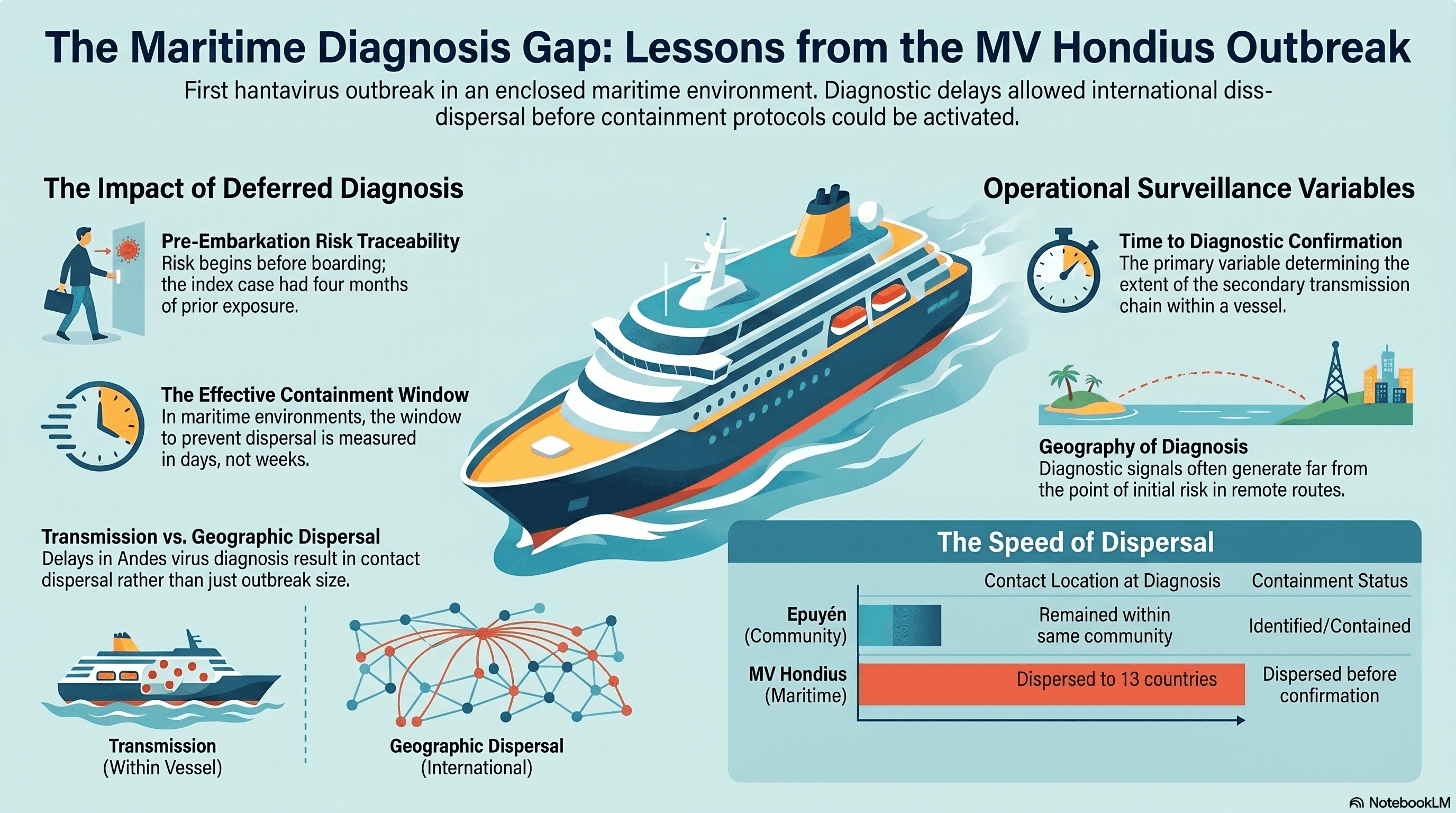
The 2018 Epuyén outbreak provides the most directly comparable reference in terms of human-to-human transmission dynamics. In that case, the transmission chain also originated from an index case with prior zoonotic exposure and propagated through close-contact settings — family gatherings, a wake — before the pattern of secondary transmission was identified. The epidemiological reconstruction was retrospective. The difference from the MV Hondius does not lie in the viral biology — the strain and its transmission characteristics are essentially the same — but in the speed of geographical dispersal of exposed contacts. In Epuyén, contacts remained within the same community long enough to be identified. In the MV Hondius, contacts were in thirteen countries before diagnostic confirmation existed.
That difference is, in operational terms, the variable that defines the specific risk profile of high international mobility environments. Not the virulence of the agent. Not the density of the enclosed space. The speed at which potential contacts exit the operational traceability radius before the surveillance system has generated a confirmatory diagnostic signal.
Operational Implications for Surveillance in High-Mobility Environments
Analysis of the MV Hondius from an epidemiological surveillance perspective identifies three operational variables that the event documents with precision: the time to diagnostic confirmation, the geography of diagnosis relative to the point of risk, and the traceability of the data generated. The three are causally related, as a deficit in any one of them conditions the capacity for response across the others.
The first variable — time — defines what can be described in operational terms as the effective containment window. In an enclosed environment moving through international space, that window is not measured in weeks but in days, as the dispersal of contacts begins the moment any passenger disembarks or alters their itinerary. In the case of the MV Hondius, the window closed on 24 April, when the first thirty passengers disembarked at Saint Helena without diagnostic information that might have conditioned their subsequent behaviour. Molecular confirmation arrived eight days later. During that interval, potential contacts had already initiated intercontinental flights, crossed borders, and entered into contact with populations in their home countries. Time-to-Containment — the time elapsed between a well-founded epidemiological suspicion and the real capacity to activate containment protocols — cannot be compressed by acting on the response following diagnosis. It can only be compressed by shortening the interval between the clinical event and molecular confirmation.
The second variable — the geography of diagnosis — is the one the MV Hondius illustrates with the greatest structural clarity. Confirmation of the Andes virus required the intervention of the Malbrán Institute in Argentina as the reference laboratory, the urgent shipment of reagents to five countries, and weeks of international coordination for receiving laboratories to process samples from an agent outside their standard diagnostic panel. That journey — from the biological sample obtained at sea to molecular confirmation in a terrestrial reference laboratory thousands of kilometres away — is not a problem of procedural efficiency. It is the structural consequence of a diagnostic model that locates confirmation capacity in centralised high-complexity nodes, remote by definition from the point where the epidemiological event occurs. The epidemiological literature on emerging zoonosis surveillance has consistently documented that the distance between the clinical event and the diagnostic capacity is one of the most robust predictors of delayed response activation, as each intermediate logistical step — sample preservation, transport, chain of custody, processing at destination — adds time and introduces potential points of data degradation.
The third variable — traceability — is perhaps the one that reveals the systemic dimension of the problem with the greatest clarity. The contact tracing operation generated by the MV Hondius outbreak was, in terms of logistical complexity, disproportionate to the size of the outbreak itself. Thirteen countries, dozens of commercial flights, hundreds of contacts to trace, 42-day quarantine protocols applied across health systems that had never managed a hantavirus case. That disproportion is not a critique of the international response, which by all accounts was swift and coordinated. It is a precise description of what happens when the diagnosis arrives after the dispersal: the containment effort grows non-linearly with each day of delay, as reconstructing exposure chains retrospectively demands resources that an early confirmation would have rendered largely unnecessary.
There is also a traceability dimension that the MV Hondius leaves partially unresolved, with implications for future surveillance: the precise origin of the index case's zoonotic exposure. The Argentine Ministry of Health published a report on 6 May detailing the Dutch passenger's movements during his four months of prior travel. Active investigation included the capture and analysis of rodents along his route through Argentina, Chile, and Uruguay. Without precise geospatial confirmation of the exposure point, surveillance of the implicated endemic zone cannot be activated with the required specificity. The diagnostic data generated on board — late, at extraordinary resource cost, following three deaths — did not include the contextual information that would have allowed the complete epidemiological cycle to be closed. A surveillance system capable of generating diagnostic intelligence at the point of risk, integrated with trajectory and exposure metadata, would have produced an operationally different dataset from the one ultimately obtained.
None of these three variables — time, geography of diagnosis, traceability — is independent of the others. They condition one another mutually, as a delayed diagnosis produces data of lower epidemiological value, greater dispersal of contacts, and a more resource-intensive containment effort. And all three converge on a common structural limitation: the centralised molecular surveillance model was not designed to operate in high international mobility environments where the effective containment window closes before the sample reaches the reference laboratory.
What the Case Leaves Documented
On 11 May 2026, ten days after the first molecular confirmation, Spain's Minister of Health officially declared the MV Hondius repatriation operation concluded. By then, 125 passengers and crew had been evacuated from the vessel, distributed across quarantine units on several continents, and the operation had involved diplomatic coordination among more than a dozen states, military deployment — including British paratroopers who jumped onto Tristan da Cunha from a RAF A400M to attend to a resident of the island who had been on board — government medical repatriation flights, and the activation of CDC level 3 emergency response systems. All of this for an outbreak that, in terms of confirmed cases, did not exceed ten.
The disproportion between the size of the event and the magnitude of the response does not reflect an overreaction by international health systems. It reflects the real operational cost of managing an outbreak when the diagnosis arrives after the dispersal. Every extraordinary resource mobilised — every repatriation flight, every activated quarantine unit, every laboratory repurposed to process an agent outside its standard panel, every contact chain reconstructed retrospectively — represents work that an early diagnosis would have made, to a greater or lesser extent, unnecessary.
The MV Hondius outbreak did not occur in an epidemiological vacuum. On 19 December 2025, PAHO had issued an epidemiological alert in response to the increase in hantavirus cases across the Southern Cone: 229 confirmed cases and 59 deaths in eight countries up to epidemiological week 47 of that year. By epidemiological week 15 of 2026, 94 cases and 13 deaths had already been reported, with Chile recording 38 cases and Argentina 32. The Andes virus was actively circulating, with a case fatality rate that in recent cycles had approached 33% in Argentina. That information was public, accessible, and technically sufficient to justify reinforced surveillance protocols at any embarkation point in the region. The MV Hondius departed Ushuaia on 1 April 2026, at the height of the virus's most active season, without on-board molecular confirmation capacity for the most lethal agent actively circulating in its area of origin.
There is a question the case leaves implicit, and one that operational epidemiology should formulate with precision: how many events sharing the same structure — zoonotic exposure in an endemic zone, non-specific prodrome, deferred confirmation, dispersal of contacts — occur without the elements that made this one visible? The MV Hondius was identified because its passengers had the resources to seek high-level medical care across multiple countries, because the nationality of the deceased activated surveillance systems in Europe and North America, and because the concentration of cases in a documented physical space facilitated epidemiological reconstruction. The hantavirus outbreaks occurring in rural communities across the Southern Cone — where between 2025 and 2026 some 86 cases and 28 deaths were reported with a case fatality rate of 33.6% — did not generate an equivalent international response, not because they were less severe, but because they occurred in environments where diagnostic silence does not produce visible intercontinental dispersal.
Modern epidemiological surveillance faces in the MV Hondius a documented demonstration of its structural limits in high-mobility scenarios. Not a demonstration that the Andes virus is more dangerous than previously known — the WHO was explicit that pandemic risk was low and transmissibility limited — but a demonstration that the existing diagnostic architecture is not designed to generate molecular intelligence at the point and moment when that intelligence has operational containment value. When the diagnosis arrives, the contacts are already in thirteen countries. When the reagents arrive, they are needed simultaneously in five laboratories. When the traceability chain is reconstructed, it already requires coordination across a dozen national health systems that had never managed this agent before.
The MV Hondius arrived in Rotterdam on 18 May 2026, with its remaining crew on board. The sanitary operation remained active across several countries. The Andes virus continued circulating in the Southern Cone with the same epidemiological parameters it had carried before the outbreak. And the next expedition to Ushuaia was, presumably, already on the calendar.