Ignacio Calvo
Reading time:
10
min
The Confirmation Gap as a Systemic Vulnerability: Epidemiological Data Fragmentation in the 2026 Bundibugyo Outbreak
From 3.2% to 8.5% confirmation rate over four days — while the absolute gap kept widening. How the structural distance between case generation and molecular confirmation determines whether epidemiological traceability can operate at outbreak speed.
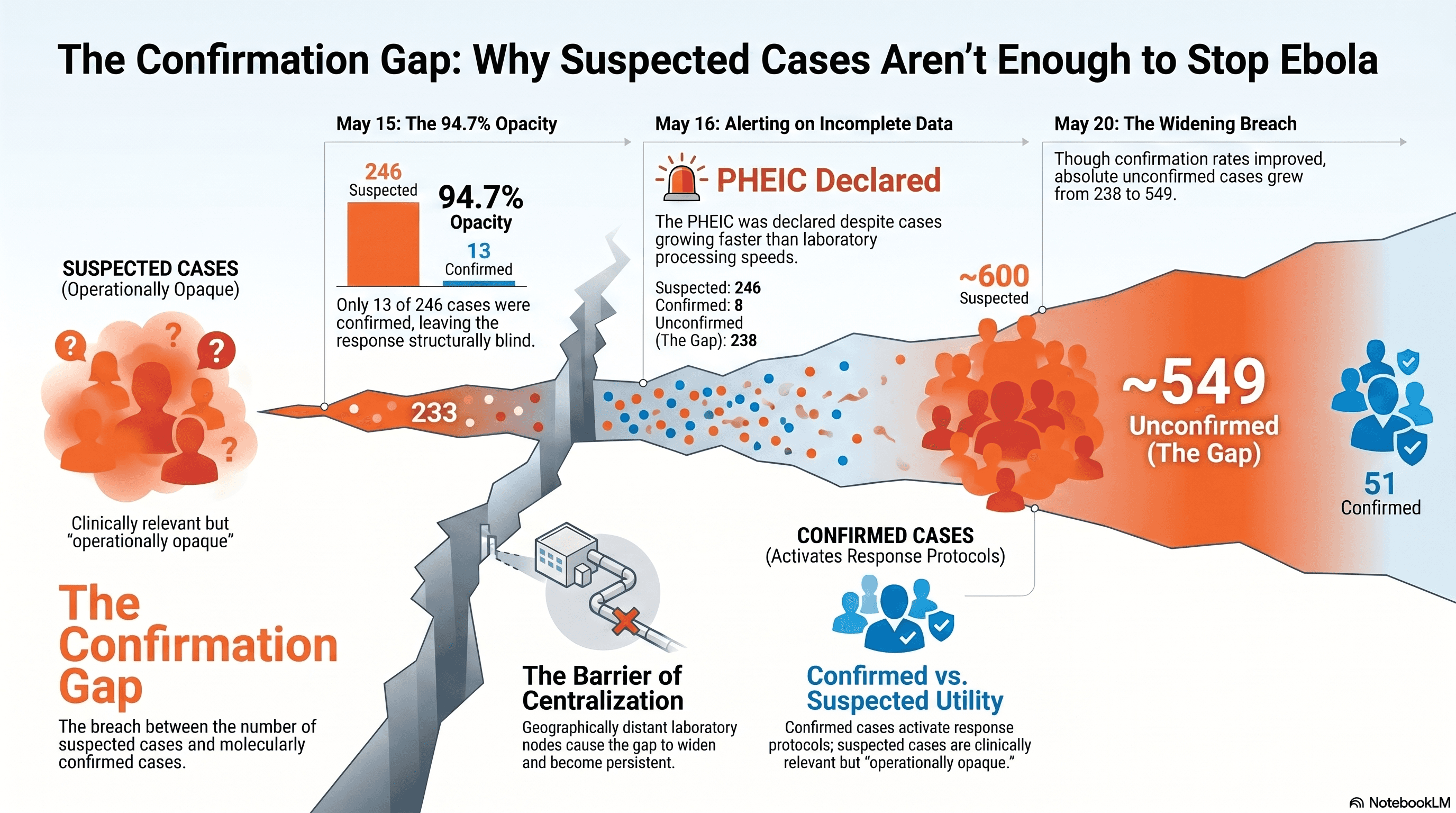
In operational epidemiology, the difference between a suspected case and a confirmed case is not merely a difference of diagnostic certainty. It is a difference of operational utility. A molecularly confirmed case generates verifiable traceability, allows transmission chains to be reconstructed with sufficient precision for contact tracing, feeds epidemiological models with data that permit real-time estimation of outbreak reproduction dynamics, and activates response protocols that depend on molecular confirmation as their activation threshold. A suspected case produces none of these consequences with the same precision. It is clinically relevant and epidemiologically indicative, but operationally opaque: the system can see it, but cannot act on it with the same efficacy as on a verified case.
The Confirmation Gap designates the breach between the number of suspected cases and the number of molecularly confirmed cases at a given point in an outbreak. Under conditions of distributed diagnostic capacity and adequate functioning, that breach is small and transient: suspected cases convert to confirmed within hours, and the response operates on verifiable data. When confirmation capacity is centralised in a single node geographically distant from the epicentre, the Confirmation Gap widens and becomes persistent, producing a situation in which the response must be managed over a fragmented epidemiological picture, with a margin of uncertainty that containment models cannot absorb without significant loss of operational precision.
The PHEIC declaration of 16 May 2026 acknowledged explicitly "significant uncertainties to the true number of infected persons and geographic spread associated with this event", adding that the high positivity rate of initial samples and the confirmation of cases in Kampala pointed toward a potentially much larger outbreak than what was being detected and reported at that moment. That formulation, incorporated into the official declaration document of the highest alert level under the International Health Regulations, is the institutional description of a Confirmation Gap of operationally critical proportions: the world's most coordinated response system activated its maximum alert on the basis of data that its own authors recognised as structurally incomplete. The Magnitude of the Gap: Three Temporal Cross-Sections
Available data allow the evolution of the Confirmation Gap during the outbreak's critical days to be reconstructed with sufficient precision to identify its structure and dynamics. Three temporal cross-sections documented by verifiable primary sources define that arc.
On 15 May, one day before the PHEIC declaration, Africa CDC had reported 246 suspected cases and 80 deaths, primarily in the Mongbwalu and Rwampara health zones. Of those 246 suspected cases, 13 had been confirmed through diagnostic testing, of whom 4 had died. The proportion of confirmed cases over total suspected cases at that point was 5.3%. The remaining 94.7% of cases the response had to manage were epidemiologically opaque.
The following day, at the moment of the formal PHEIC declaration, eight laboratory-confirmed cases had been reported against 246 suspected cases and 80 suspected deaths in Ituri, alongside two confirmed cases in Kampala. The slight reduction in confirmation proportion did not reflect a deterioration in diagnostic capacity but the speed at which the denominator of suspected cases was growing relative to the rate of confirmation: the system was confirming, but the outbreak was generating new cases faster than the system could process them.
Four days later, on 20 May, the LSHTM updated its rapid analysis to reflect almost 600 suspected cases and 51 confirmed, with 139 suspected deaths in the DRC. The confirmation ratio had improved from 3.2% to 8.5%, a real advance in confirmatory capacity. However, the gap in absolute terms had widened: from 238 unconfirmed suspected cases on 16 May to approximately 549 on 20 May. The speed of uncertainty generation structurally exceeded the speed of its resolution.
The LSHTM stated explicitly that "there remains an important distinction between suspected and laboratory-confirmed cases, and that additional laboratory confirmation and epidemiological investigations will be essential to better understand the scale, transmission dynamics, and origin of the outbreak." That observation, formulated by one of the world's highest epidemiological authority institutions about an already-declared PHEIC, confirms that the Confirmation Gap is not a transient problem of the first days. It is a structural condition that persists as long as the confirmation architecture cannot operate at the speed the outbreak's dynamics impose.
What the Gap Does to the Response Model
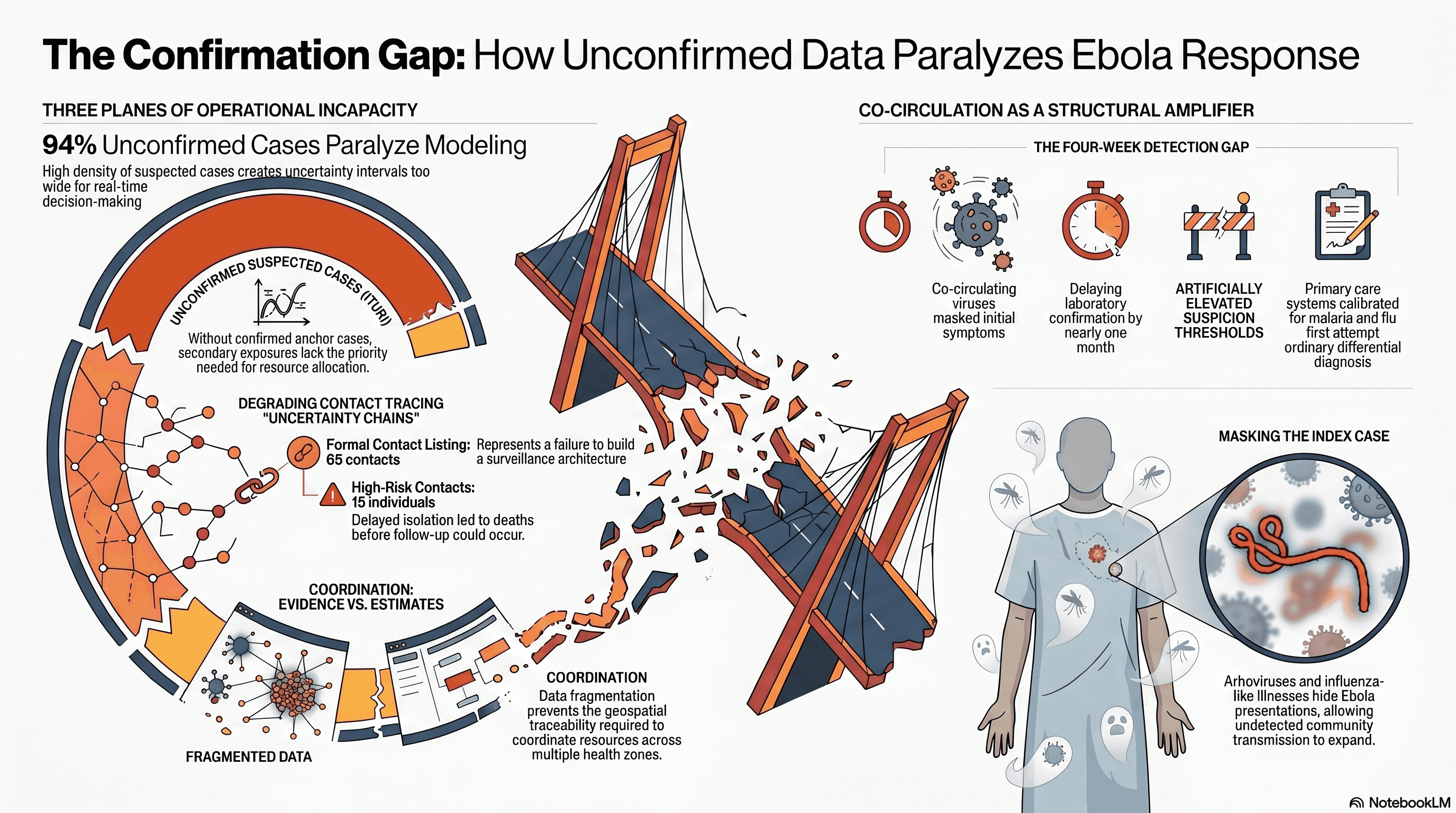
The Confirmation Gap does not produce only statistical uncertainty. It produces operational incapacity across three specific planes that analyses of the Bundibugyo outbreak have tended to treat in aggregate, when in reality they operate through distinct mechanisms and generate distinct consequences for coordinated response.
The first affects the modelling of transmission dynamics. Estimating the effective reproduction number of an outbreak, the variable that determines whether transmission is being reduced below the containment threshold, depends on the quality and density of confirmed case data. Epidemiological models developed from the West Africa outbreak documented that transmission coefficients of suspected cases present weaker correlations with the basic reproduction number than those of confirmed cases, since suspected cases incorporate a heterogeneous mixture of real cases and other co-circulating febrile illnesses. An outbreak managed with 94% of unconfirmed suspected cases, as occurred in Ituri on 16 May, produces models with uncertainty intervals wide enough that their operational utility for real-time decision-making is substantially limited. The response can operate, but it does so with an epidemiological picture that does not permit knowing with precision whether active containment measures are sufficient.
The second plane affects contact tracing as a containment mechanism. Reconstructing verifiable transmission chains requires confirmed anchor cases from which secondary exposures can be traced with sufficient certainty to prioritise surveillance. When the anchor case is suspected, the tracing generates an accumulated uncertainty chain that degrades at each link: a contact of a suspected case who develops symptoms is a second-level suspected case, with lower certainty of causal relationship and lower operational priority in the allocation of follow-up resources. On 15 May, when the official response was activated, only 65 contacts had been formally listed across hundreds of suspected cases, 15 classified as high risk, and several of those contacts had already developed symptoms and died before they could be isolated. The Confirmation Gap was not the sole cause of that tracing failure, but it was one of its structural determinants: without confirmed anchor cases in sufficient density, contact tracing cannot build the surveillance architecture that containment requires.
The third plane affects geospatial epidemiological traceability, the operational dimension most directly related to coordinating a response distributed across multiple health zones simultaneously. Africa CDC warned that outbreak figures remained provisional and were being validated through laboratory confirmation, case list harmonisation, contact identification, and epidemiological investigation. That pending harmonisation is not an administrative problem. It is the reflection that data fragmentation prevents generating the geospatial traceability necessary to coordinate resources between health zones with different levels of active transmission, different local response capacities, and different cross-border dispersal risk profiles. When data are predominantly suspected, coordination operates on estimates. When they are predominantly confirmed, it operates on evidence. Co-circulation as a Structural Amplifier
The analysis of the Confirmation Gap in the 2026 Bundibugyo outbreak would be incomplete without examining a factor that the WHO documented in its official report and that subsequent analyses have tended to treat as general epidemiological context, when in reality it operates as a structural amplifier of the gap acting in parallel with the diagnostic mechanisms already described.
The WHO identified that the four-week detection gap between symptom onset of the presumed index case and laboratory confirmation of the outbreak suggested a low clinical index of suspicion among healthcare providers, and that this was compounded by the presence of co-circulating arboviruses and influenza-like illnesses masking the initial clinical index of suspicion for Ebola disease and exacerbating community transmission.
That phenomenon has a specific operational implication for the Confirmation Gap worth stating precisely. In an environment where malaria, dengue, typhoid fever, and acute respiratory infections are endemic and actively co-circulating, each febrile case with mild haemorrhage can initially be classified as one of those more common and more treatable conditions. The result is not only that Ebola cases go undetected in time: the activation threshold of the Ebola suspicion protocol is artificially elevated, because the primary care clinical system is calibrated for the most probable conditions of the habitual epidemiological environment. Co-circulation converts each atypical Bundibugyo presentation into a case the system first attempts to resolve through the ordinary differential diagnosis, escalating toward Ebola suspicion only after that differential fails across successive rounds of treatment without response. That sequential elimination process introduces additional days of Confirmation Gap into each individual case, which accumulate on top of the structural diagnostic delay already analysed.
The compound mechanism that results has a property particularly difficult to manage from a centralised response: it cannot be corrected solely through improvements in reference laboratory confirmation capacity, because the problem does not begin at the laboratory. It begins at the moment the case enters the primary care system without activating Ebola suspicion, and during the time that elapses before that suspicion is activated, the case does not reach the laboratory at all, whether confirmed or suspected. Traceability as Infrastructure, Not as Outcome
The Confirmation Gap of the 2026 Bundibugyo outbreak exposes a principle that modern epidemiological surveillance systems tend to assume as given, and that this outbreak demonstrates is not: epidemiological traceability is not an automatic by-product of molecular diagnosis. It is a property of the system that requires confirmation to occur with sufficient speed, density, and geographic distribution for the epidemiological chain to be reconstructed before secondary transmission renders it operationally unrecognisable.
In Ituri, between 16 and 20 May, the system's confirmatory capacity improved: confirmed cases rose from 8 to 51. But the uncertainty denominator grew from 246 to nearly 600 suspected cases over the same period. The operational traceability of the outbreak did not improve in the same proportion as confirmation capacity, because the speed of suspected case generation structurally exceeded the speed of gap resolution. The system worked, but it worked on a terrain that expanded faster than it could be covered.
That dynamic is not specific to the Bundibugyo outbreak. It is the operational expression of an architectural principle that epidemiological literature has identified consistently: in environments of high incidence and low distributed diagnostic capacity, the Confirmation Gap tends to widen with the outbreak rather than narrow, because centralised confirmation capacity has a fixed operational ceiling while suspected case generation does not. The result is a system confirming at constant speed against a denominator growing at accelerating rate, producing an epidemiological picture that becomes progressively more fragmented as the outbreak scales.
The architectural implication this analysis establishes is operationally concrete: surveillance systems that depend on centralised confirmation to generate traceability produce, under conditions of high suspected case generation, a persistent Confirmation Gap whose magnitude is proportional to the operational distance between the point of case generation and the point of confirmation. That distance, unlike the pathogen's reproduction number or the population density of the epicentre, is a variable that diagnostic architecture can modify. Epidemiological traceability cannot be built retroactively over an outbreak that has already exceeded the system's confirmation speed. It must be present from the outset, at the point where the case is generated, not only at the point where it can eventually be confirmed.
References: 1. WHO. "Ebola disease caused by Bundibugyo virus, DRC and Uganda." DON602. 16 May 2026. https://www.who.int/emergencies/disease-outbreak-news/item/2026-DON602 2. WHO. "Epidemic of Ebola Disease determined a PHEIC." 17 May 2026. https://www.who.int/news/item/17-05-2026 3. LSHTM. "Rapid reaction: Ebola outbreak in DRC and Uganda." Updated 20 May 2026. https://www.lshtm.ac.uk/newsevents/news/2026/rapid-reaction-ebola-outbreak-drc-and-uganda 4. Imperial College London. "Ebola outbreak 2026: Q&A with experts." 15 May 2026. https://www.imperial.ac.uk/news/articles/2026/ebola-outbreak-2026-qa-with-experts/ 5. Africa CDC. "Africa CDC Calls for Urgent Regional Coordination Following Ebola Outbreak in Ituri Province." 15-16 May 2026. https://africacdc.org 6. Chowell G, Viboud C. "Modeling Contact Tracing in Outbreaks with Application to Ebola." ArXiv. 2015. https://arxiv.org/pdf/1505.03821
7. Wang XS, et al. "A Model of the 2014 Ebola Epidemic in West Africa with Contact Tracing." PMC. 2015. PMID: 25688738
8. Fang H, et al. "Modeling the transmission dynamics of Ebola virus disease in Liberia." Scientific Reports. 2015;5:13857. DOI: 10.1038/srep13857