Ignacio Calvo
Reading time:
10
min
Zoonotic Event Mapping and Operational Traceability: Hantavirus as a Structural Case for Distributed Epidemiological Intelligence
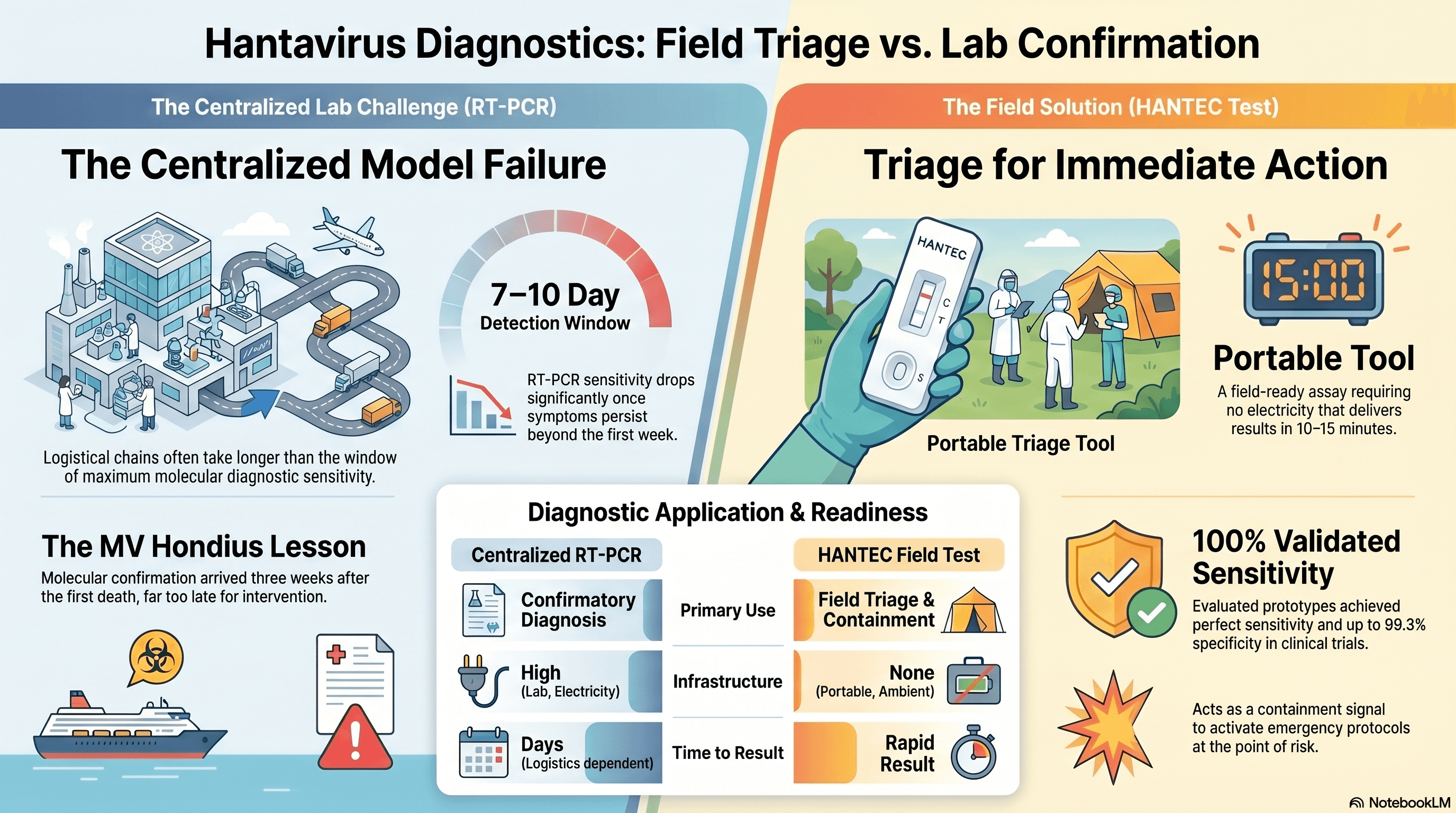
The MV Hondius outbreak exposed a structural gap: diagnostic results existed, but not the integrated traceability architecture to make them operationally useful in time.
The Difference Between a Diagnostic Result and Structured Epidemiological Data
Between 3 and 8 May 2026, reference laboratories in Argentina, South Africa, Switzerland, the Netherlands, and the United Kingdom confirmed cases of Andes virus infection linked to the MV Hondius. Each of those results was analytically correct, clinically useful for the patient in question, and generated to the technical standards that the health systems of those countries apply to high-containment pathogens. From the perspective of individual diagnosis, the system worked. From the perspective of distributed epidemiological surveillance, the system produced something qualitatively different from what the scenario required.
The results arrived on different days, from national systems with heterogeneous notification formats, without shared contextual metadata, and without automatic integration into a common epidemiological map. The WHO and the national focal points of the International Health Regulations had to manually assemble, under time pressure and with partial information, the epidemiological picture that those individual results did not produce in an integrated manner. The coordination operation that followed — 13 countries, dozens of flights to trace, hundreds of contacts to locate — was in part the cost of that absence of integration, as each piece of information the system had to reconstruct retrospectively was a piece that a prospective traceability architecture would have produced in structured form from the outset.
That observation leads to a distinction this article proposes as its analytical axis: the difference between a diagnostic result and structured epidemiological data. The first is the confirmation of which agent causes the clinical presentation observed in a specific patient. The second is that same confirmation enriched with the information that gives it surveillance value beyond the individual case: who obtained the sample, when, where exactly, in what declared exposure context, with what level of environmental risk, with what recent mobility history of the subject, and in what relationship to other known cases or contacts. The distance between those two concepts is not technological in terms of tool availability. It is a distance of design: of protocol, of data capture architecture, and of the decision about what information must accompany the diagnostic result from the moment it is generated.
In the MV Hondius, that distance was operationally determinative. The data existed, scattered across different systems — passenger manifests, port call records, post-disembarkation flight itineraries, exposure histories declared by cases — but were not integrated into a common architecture that would have made them accessible in useful time for the health systems of the 13 countries receiving passengers. The diagnostic result confirmed the cases. The structured epidemiological data, absent as integrated infrastructure, had to be built case by case, country by country, diplomatic channel by diplomatic channel, during the weeks in which the Andes virus incubation period — up to six weeks — kept open the possibility of new cases among unlocated contacts.
Retrospective Reconstruction as a Symptom of the Absence of Prospective Traceability
The contact tracing operation generated by the MV Hondius outbreak was, by most available analyses, a notable example of international health coordination under adverse conditions. The IHR focal points of more than a dozen countries exchanged information at a speed that formal notification mechanisms rarely achieve. The WHO deployed an expert on board, published three Disease Outbreak News reports in less than two weeks, and coordinated the production and distribution of provisional technical guidance in record time. Spain managed the evacuation of a vessel at sea carrying 147 people toward a port that initially did not want to receive it. All of that happened, and it happened well.
What this analysis proposes is not a critique of that response but a different reading of what its magnitude reveals. A contact tracing operation of that complexity — 13 countries, 147 people of 23 nationalities, dozens of connecting flights, 42 days of follow-up per person, 62 potential contacts identified in South Africa alone of which 20 remained unlocated days after the operation began, with some having already travelled abroad — is not solely the product of a difficult outbreak. It is also the product of a system that did not have, at the moment it needed them, the structured data that would have substantially reduced the reconstruction effort. Every contact that had to be manually located was, in operational terms, a contact whose information would have been available in structured form had the surveillance system integrated from the outset of the voyage data on the identity, itinerary, and exposure level of the vessel's occupants in a prospective traceability architecture.
The distinction between prospective traceability and retrospective reconstruction is not semantic. It has direct implications for the speed, cost, and completeness of the response. Prospective traceability produces structured data at the moment events occur — who was on board, what port calls the vessel made, which passengers disembarked at which point, what level of proximity they had to confirmed cases — and makes them accessible in useful time for receiving health systems. Retrospective reconstruction produces the same data, but weeks later, under pressure, with inevitable gaps, and at a cost in human resources and time that grows non-linearly with each day of delay. In the case of the MV Hondius, the reconstruction of the index case's four-month itinerary through Argentina, Chile, and Uruguay required the direct involvement of the Argentine Ministry of Health and the Malbrán Institute. Weeks after the outbreak began, the exact point of zoonotic exposure remained unidentified, and the capture and analysis of rodents along the index case's route continued without a conclusive published result.
That inability to locate the origin with precision is not a failure of epidemiological investigation. It is the structural consequence of surveillance data for the animal reservoir in the zones traversed by the index case not existing in real time or with the geospatial resolution necessary to correlate them with the itinerary of a specific human case. The One Health cycle — from the infected rodent in some point of Patagonia or the Andes to the human case on the MV Hondius to the diagnostic confirmation in laboratories across five countries — is not closed because its components are not connected in an integrated traceability architecture. And a cycle that does not close does not provide feedback. It does not make future surveillance more intelligent. It leaves the same blind spot in the same place for the next event.
There is a concrete data point from the MV Hondius operation that illustrates the difference between both types of traceability with particular clarity. The study published in NEJM in 2020 on the Epuyén outbreak used next-generation sequencing and stochastic modelling to reconstruct with precision the transmission chains of that outbreak. That work was possible because the 34 cases remained in a geographically bounded community long enough to be identified and sampled. In the MV Hondius, the same reconstruction — applied to 147 people dispersed across 13 countries, with transmission chains that developed partly at sea and partly across multiple transit airports — cannot be produced with the same completeness, not because the analytical tools are insufficient, but because the contextual data needed to feed them were not captured in structured form at the moment the event occurred. The genomic sequences of the Andes virus isolated from the Swiss case were published on Virological.org on 8 May with remarkable speed. The complete epidemiological chain explaining how that virus reached that passenger at that point in the voyage remains, in relevant aspects, an incomplete reconstruction.
The Incomplete Epidemiological Cycle: When the Data Does Not Close the Origin
The epidemiological investigation of a zoonotic outbreak has, in its most complete formulation, two simultaneous directions. One moves forward: it identifies cases, characterises the transmission chain, locates contacts, and activates containment protocols. The other moves backward: it reconstructs the origin, identifies the point of exposure in the animal reservoir, characterises the ecological conditions that made it possible, and feeds back into the surveillance system with information that reduces the probability of the same blind spot generating the next event. The MV Hondius outbreak activated the first direction with notable effectiveness. The second remains, weeks after the start of the operation, structurally incomplete.
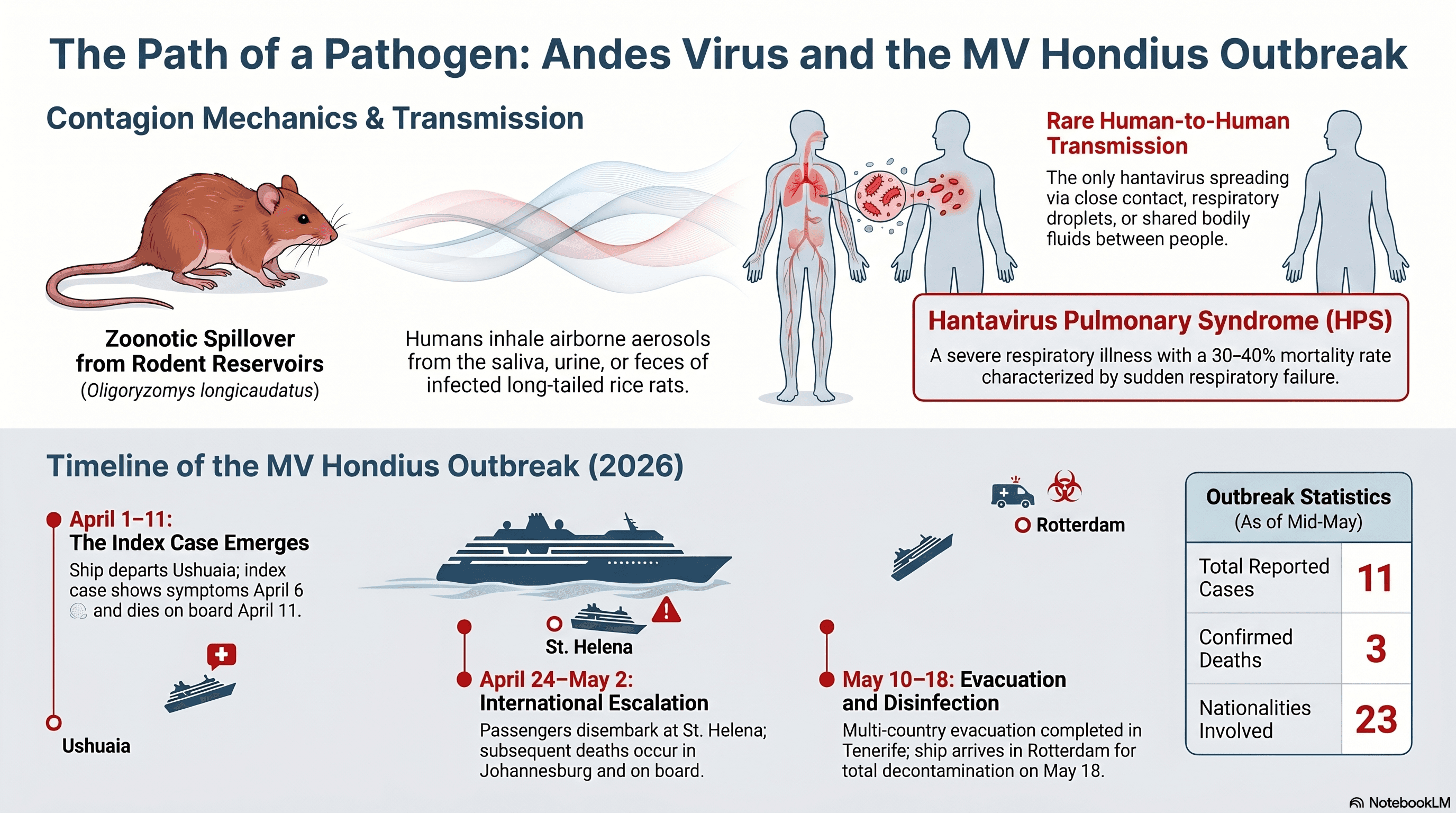
The index case — a 70-year-old Dutch national — undertook between 27 November 2025 and 1 April 2026 a four-month journey through Argentina, Chile, and Uruguay. He boarded in Ushuaia on 1 April. He began showing symptoms on 6 April and died on 11 April. The working hypothesis of the investigation is that he acquired the infection during that pre-embarkation journey, through zoonotic exposure to Oligoryzomys longicaudatus at some point along his itinerary. The Argentine Ministry of Health published the detail of his movements on 6 May and activated the capture and analysis of rodents along his route. As of the most recent available reports, the exact point of exposure had not been identified.
That inability has a structural explanation that does not depend on the quality of the investigation or the speed of response of Argentine health authorities, which by all accounts was swift and transparent. It depends on active surveillance of the hantavirus reservoir in the Southern Cone not generating, under normal conditions, data with the geospatial and temporal resolution necessary to correlate with the itinerary of a specific human case. Rodent surveillance programmes in endemic zones typically operate through periodic sampling at fixed points, with seasonal frequency and a lag between sampling and result availability that can be measured in weeks. That design is adequate for characterising reservoir population trends at regional and broad temporal scale. It is not adequate for responding, in operationally useful time, to the question of whether an infected rodent was present in a specific location during a temporal window of days or weeks corresponding to the itinerary of a human case.
The operational consequence of that lag is what this analysis terms the incomplete epidemiological cycle: the system identifies the human case, confirms the agent, partially reconstructs the interpersonal transmission chain, but cannot close the loop connecting the last human link to the first animal link. And a cycle that does not close does not provide feedback. The zone where the MV Hondius index case acquired the infection — in all probability somewhere along his journey through the Patagonian steppe or the Andean valleys — cannot activate specific reinforced surveillance until that point is identified with precision. Without that identification, the surveillance system is no more intelligent after the MV Hondius outbreak than before it with respect to the risk in that specific zone.
There is an additional element in this dimension that the outbreak's coverage has not developed with sufficient precision and that has direct implications for future surveillance architecture. The study on the Epuyén outbreak published in NEJM in 2020 documented that a single zoonotic introduction generated four generations of human-to-human transmission, with three cases identified as super-spreaders in high-interaction social events. The investigation was able to reconstruct that chain with precision because the cases remained in a geographically bounded community. What that study could not determine with certainty — and what the MV Hondius has also not determined — is what specific characteristics of the original zoonotic exposure event conditioned the subsequent interpersonal transmission capacity. If that information existed in structured form — environmental conditions at the point of exposure, reservoir density in the zone, estimated viral load of the source rodent — it would provide evidence on the parameters that make the transition from a zoonotic spillover to a sustained human transmission chain more probable. That is the information the incomplete epidemiological cycle does not produce, and that the next event will need if it is to be managed with greater precision than the current one.
The difference between a surveillance system that closes the cycle and one that leaves it open is not solely a difference of scientific rigour. It is a difference of predictive capacity. A system that integrates reservoir surveillance data — geospatial distribution of infected Oligoryzomys, seasonal fluctuations in population density, correlation with documented climatic variables — with human mobility data in those same zones can generate, in principle, a probabilistic risk signal before the first human case is confirmed. Not as a deterministic prediction, but as a probabilistic alert that orients the intensity of active surveillance toward specific temporal and geographic windows. That is the operational value of the closed cycle: not only explaining what occurred, but reducing the distance between the ecological event and the first signal from the surveillance system in the next one. Components of an Operational Traceability Architecture for High-Mobility Zoonotic Events
The analysis of the preceding sections defines with sufficient precision the problem: the absence of an integrated traceability architecture that connects the individual diagnostic result with the epidemiological context that gives it surveillance value, that closes the cycle between the human case and the zoonotic origin, and that produces distributed epidemiological intelligence in operationally useful time. What remains is to articulate, from available evidence and without compromising proprietary technical specificity, what components that architecture should include.
The first of those components is the integration of contextual metadata into the diagnostic result from the moment of its generation. An RT-PCR result positive for Andes virus that includes only the identification of the agent and the cycle threshold value has complete clinical value and limited epidemiological value. The same result enriched with geolocation of the sample collection point, precise temporality, the patient's declared mobility history in the preceding weeks, exposure context — activities undertaken, environments frequented, known risk contacts — and epidemiological risk level of the immediate environment generates a data point that can contribute automatically to an active surveillance system without requiring subsequent manual reconstruction. The difference between the two does not reside in the analytical complexity of the molecular assay. It resides in the data capture protocol at the diagnostic moment and in the architecture that receives, stores, and makes them accessible in interoperable format.
That integration is not conceptually new. Disease notification systems for mandatorily reportable conditions incorporate, in their most advanced formats, epidemiological context fields that go beyond agent identification. What the MV Hondius scenario illustrates is the gap between that capacity in centralised laboratory environments with established digital infrastructure and the same capacity in high-mobility, low-infrastructure, multi-jurisdiction environments. At sea, on a remote South Atlantic island, at a transit airport, the protocol for capturing contextual epidemiological data does not exist as an operational standard. The diagnostic result, when it is finally generated, arrives without the layer of information that would make it immediately useful for distributed surveillance.
The second component is interoperability between national notification systems, which the literature on distributed epidemiological surveillance consistently identifies as the primary technical bottleneck in multinational data integration. In the MV Hondius outbreak, the IHR focal points of 13 countries coordinated information exchange through established but non-automated channels. That process worked, but produced integrated epidemiological intelligence with a delay measured in days relative to the events it described — in a scenario where the Andes virus incubation period of up to six weeks made each day of delay an additional window of uncertainty about potentially exposed contacts. An interoperability architecture based on open standards and harmonised notification formats would not eliminate the need for human coordination between national health systems, which also responds to governance and sovereignty dynamics that no technical standard resolves on its own. But it would reduce the time between the generation of the national data point and its integration into the global epidemiological map from days to hours — a difference that, in an event with active international dispersal, is operationally significant.
Research on epidemic surveillance technologies has explored in recent years distributed ledger architectures as a mechanism for guaranteeing the integrity and traceability of epidemiological data in multinational contexts where authority over that data is shared and where inter-system trust is a functional condition. The logic is direct: an epidemiological data point whose chain of custody is verifiable and unalterable generates greater trust between national systems sharing information under time pressure than one whose integrity depends on the institutional reputation of the system that emits it. That technical trust is a condition of real interoperability, not merely formal interoperability.
The third component — One Health integration of reservoir data in operationally useful time — is the one that closes the epidemiological cycle the preceding sections left open. Rodent surveillance programmes in endemic hantavirus zones in the Southern Cone generate data of undoubted scientific value for characterising population trends at broad regional and temporal scale. What they do not generate, in their current design, is data with the geospatial and temporal resolution necessary to correlate in useful time with the itinerary of a specific human case. Closing that gap requires two things that are not technologically unachievable but that imply system design decisions: first, reservoir sampling protocols that capture data with sufficient geospatial precision and with temporality compatible with the speed of epidemiological response; and second, integration architectures that connect those animal surveillance data with human case data on the same analytical platform, so that geospatial correlation between both sources is automatic and does not require subsequent manual synthesis.
None of those three components operates in isolation with the maximum value it can generate. Their real value is systemic: it emerges from the connections between them. Contextual metadata integrated into the diagnostic result that does not flow toward an interoperable system accumulates in national silos without generating distributed intelligence. Interoperability between national systems that does not include animal reservoir data produces maps of human cases without ecological context, which prevents the cycle from closing. And reservoir data integrated without a verifiable digital chain of custody generates uncertainty about their reliability that reduces their utility in multinational decision-making contexts under pressure. The operational traceability architecture for high-mobility zoonotic events is not the sum of its components. It is the design of the connections between them.
Traceability as Infrastructure, Not as Record
Epidemiological traceability is frequently conceptualised as a recording function: the documentation, after the event, of who was where, what contacts they had, what diagnostic result they received. That conception is not incorrect, but it is incomplete in a way that has direct operational consequences. A traceability system designed as a record produces documentation. A traceability system designed as infrastructure produces intelligence. The difference does not reside in the data it captures — which may be identical — but in the moment it captures them, in the way it structures them, and in the speed at which it makes them available to the actors who need to act on them.
The MV Hondius outbreak illustrates that difference with a clarity that could hardly be constructed as a theoretical exercise. The information that would have constituted effective prospective traceability existed in large part before the outbreak was identified: passenger and crew manifests, vessel port call itineraries, records of partial disembarkations, connecting flight data for passengers who left the ship before diagnostic confirmation. That information was dispersed across systems not designed to communicate with each other at the speed the event required: the cruise operator's records, the border control systems of port call countries, airline databases, the health notification systems of receiving countries. When the WHO activated its response on 2 May, all of that information had to be summoned manually, negotiated in some cases through diplomatic channels, and assembled into a coherent picture by teams that worked for days without having the complete picture.
That work was, in large part, the conversion of existing data into operationally useful information. Not the creation of new data. What was missing was not the information itself, but the architecture that would have made it accessible in useful time and form before the system needed it urgently. That distinction — between data that exists and data that is available as active infrastructure — is what defines whether traceability operates as post-hoc record or as a structural component of response capacity.
The temporal dimension of that distinction deserves explicit development because it is where the operational value of traceability as infrastructure is most evident. Before the event, an integrated traceability architecture that correlates reservoir surveillance data with human mobility patterns in endemic zones can generate probabilistic alert signals that orient the intensity of active surveillance. Not predictions, but indicators of elevated risk windows in specific geographies and temporalities. In the case of hantavirus in the Southern Cone, fluctuations in Oligoryzomys population density are documented as a function of climatic variables and food availability that are monitorable in relatively real time. Correlating those data with the volume of expedition tourism activity in those same zones — which is also an available data point — would produce a composite risk indicator that does not exist as an operational product in any known active surveillance system.
During the event, the availability of itinerary, exposure level, and potential contact data in structured and interoperable format reduces the time for activating containment protocols and the cost of the tracing operation. The difference between locating a contact in hours because their information was available in an integrated system and locating them in days because it required manual reconstruction across multiple jurisdictions is not a difference of administrative efficiency. In a pathogen with an incubation period of up to six weeks and possible transmission during the symptomatic phase, each day's difference in locating a high-risk contact is a day during which that contact may have generated secondary exposures without awareness of their situation. Prospective traceability does not eliminate that risk, but it bounds it in a way that retrospective reconstruction cannot match.
After the event, the closure of the complete epidemiological cycle — from the human case to the point of exposure in the reservoir — feeds back into the system with information that reduces the probability of the same blind spot generating the next event. In the case of the MV Hondius, that closure has not occurred as of the date of this analysis. The exact point of zoonotic exposure of the index case remains unidentified with precision. The implicated endemic zone cannot activate specific reinforced surveillance. The surveillance system is no more intelligent with respect to that specific geographic point after the outbreak than before it. That is the most silent and most durable operational consequence of the absence of traceability as infrastructure: it not only complicates the response to the present event, but leaves unclosed the feedback loops that would make the system more capable in the face of the future event.
The MV Hondius outbreak produced, reactively and under extraordinary pressure, a notable quantity of epidemiological data of real value. The reconstructed itineraries of the index case and his partner. The genomic sequences of the Andes virus published on Virological.org on 8 May at a speed that would have been unthinkable in previous outbreaks. The provisional technical guidelines from five international bodies generated in less than two weeks. The phylogenetic analyses that ruled out relevant mutations and confirmed correspondence with the endemic Southern Cone variant. That body of evidence is genuinely valuable and will persist as a reference for the response to future hantavirus events in high-mobility environments. But it was produced, for the most part, as a response to the absence of structured data available before the system needed them. Its generation under pressure is not an argument in favour of surveillance systems not needing prospective traceability architectures. It is precisely the contrary argument: it demonstrates that the technical capacity and institutional willingness to produce high-quality epidemiological intelligence exist, and that the obstacle is not the competence of national systems or the disposition of international bodies to coordinate. The obstacle is that this capacity is activated reactively, when the event has already occurred and the data have already dispersed, rather than operating continuously as active surveillance infrastructure.
Epidemiological traceability, understood as infrastructure rather than record, is not a technical ideal of indefinitely deferred implementation. It is a design condition of modern surveillance systems whose absence has documentable costs and whose implementation has partial precedents in other domains of global health. The distance between what the MV Hondius demonstrated can be produced reactively and what a prospective traceability architecture would have produced systematically is, in operational terms, the exact measure of what current surveillance systems leave on the table in every event they manage with the instruments of the past.