Ignacio Calvo
Reading time:
10
min
Point-of-Need Molecular Surveillance in Conflict Zones: Operational Constraints and Architectural Imperatives
Ituri 2026 did not fail because the wrong decisions were made in the moment. It failed because the architecture was designed for conditions that the environment never satisfied — in any of its three fundamental dimensions.
Modern molecular diagnostic systems were conceived under an implicit premise that for decades proved operationally valid: that the epidemiological event and the diagnostic confirmation capacity coexist in the same environment, or at least in one where the distance between them can be managed logistically without relevant epidemiological consequences. That premise was defensible when documented outbreaks occurred primarily in urban environments with functional transport infrastructure, when the implicated pathogens had consolidated diagnostic profiles in the instruments available in the field, and when transmission speed was low enough that sample transit between the collection point and the reference laboratory did not introduce an operationally critical delay.
Ituri in 2026 invalidates all three conditions simultaneously. The event occurred in a remote mining zone without multi-species molecular diagnostic capacity. The sample took days to reach the only laboratory capable of processing the strain. And the pathogen was not within the profile of the instruments available in the field. What followed was not the isolated failure of any one of those factors separately. It was the systemic failure of an architecture designed for conditions that the Ituri environment did not meet in any of its three fundamental dimensions, and whose consequences the previous articles in this series have documented in detail: three weeks of Diagnostic Silence, a Confirmation Gap that reached 96.8% at the moment of the PHEIC declaration, and a Time-to-Containment that converted a localised outbreak into a cross-border event before any coordinated response could be activated.
The argument of this analysis does not treat that failure as an anomaly. It treats it as the predictable expression of a structural principle that operational literature has established with consistency: in environments where population mobility is high, health infrastructure is fragmented by conflict, and the threat profile is variable and unpredictable, the exclusively centralised diagnostic model is not suboptimal. It is architecturally incompatible with the environment in which it operates. What Kivu Taught and What Ituri Confirms
The most operationally relevant precedent for this analysis is not the 2014-2016 West Africa outbreak, whose scale and geographical context place it outside the range of direct comparison. It is the 2018-2020 Kivu outbreak, which occurred in the same provinces of eastern Congo, under comparable conditions of humanitarian and conflict complexity, and which produced the most thoroughly documented operational experience on decentralised diagnostics in environments of active insecurity available in the literature.
During the tenth Ebola virus disease outbreak in the DRC, the INRB strategically deployed 13 distributed field laboratories to rapidly detect cases as the outbreak evolved. The laboratories were operated by national staff, who quickly transferred competencies and skills to local personnel to successfully manage future outbreaks. In total, the laboratories analysed approximately 230,000 Ebola diagnostic samples under stringent biosafety measures, documentation, and database management protocols.
The operational conclusion of that deployment is direct and documented in peer-reviewed literature: deploying decentralised, well-equipped laboratories operated by local personnel in high-risk EVD countries is an efficient response in which all activities are carried out rapidly in the field. The presence of trained local laboratory workers significantly reduced the number of national and international experts required to be deployed and strengthened community engagement. Decentralised nodes were maintained to support routine EVD surveillance in remote areas and detect potential reactivations.
The 2026 Ituri outbreak confirms that conclusion by contrast. It occurred in the same province, with the same complexity profile, but without the field infrastructure that the Kivu outbreak had built and that funding cuts since March 2025 had eroded. The Kivu response had been characterised by a network of community health workers contributing to EVD surveillance whose work was a critical and largely unrecognised factor in ending the epidemic. Challenges with the collection, compilation, and analysis of community-based surveillance data made their contribution difficult to quantify. In 2026, that network no longer operated with the same coverage. The difference in outcome between the two outbreaks was not solely a difference of pathogen or circumstance. It was, in measurable part, a difference in diagnostic architecture available in the field.
The Three Dimensions That Define the Architectural Requirement
Identifying which type of environment makes an exclusively centralised diagnostic model structurally unviable requires analytical precision, because not every low-infrastructure environment presents the same profile of incompatibility. Ituri concentrates three variables that, according to available operational literature, converge to produce that incompatibility in its most severe form.
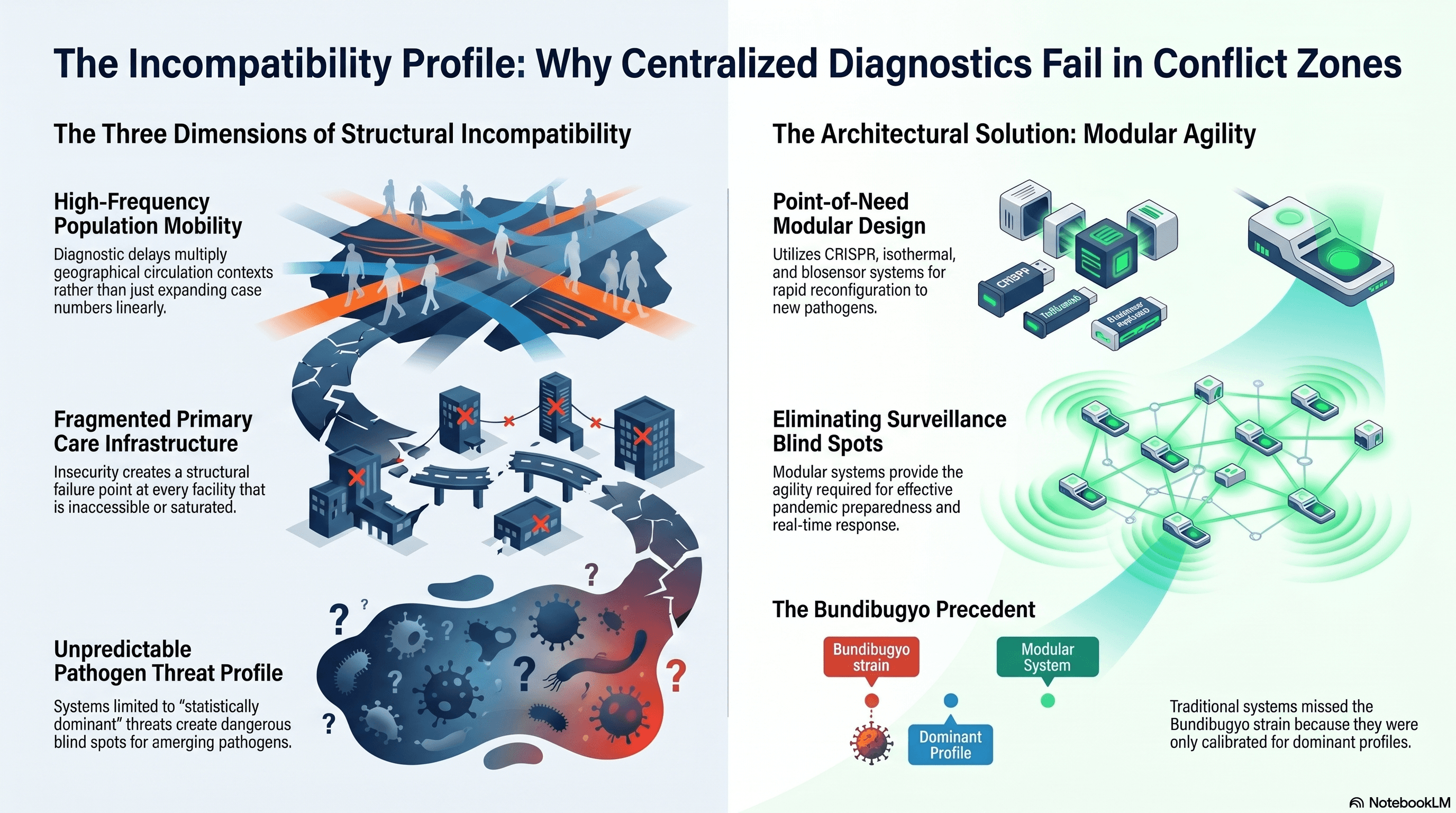
The first is high-frequency population mobility. Mining activity in Mongbwalu generates intense informal labour flows and constant movement between health zones. Ituri Province borders both Uganda and South Sudan, with the Bunia health zone located less than 500 kilometres from the Ugandan border. Over that geography lies an active armed conflict that complicates contact tracing, as populations are highly mobile and health workers have been attacked. In that environment, each day of diagnostic delay does not linearly expand the number of cases: it multiplies the number of distinct geographical contexts in which the virus is simultaneously circulating, each with its own transmission chains that the subsequent tracing system cannot reconstruct with sufficient precision for effective containment.
The second is systematically fragmented primary care health infrastructure. Active conflict in Ituri has generated attacks on health facilities, reduction of available personnel, and a primary care system operating under conditions of permanent saturation. The Kivu outbreak response documented that population mobility created severe challenges for contact tracing, testing, and isolation, and that the response was characterised by a weak early warning system that missed suspected cases and community deaths, resulting in delayed access to care and lost opportunities for outbreak control. That diagnosis, formulated about the 2018-2020 outbreak in the same province, describes with precision the conditions that reproduced in 2026 on a surveillance infrastructure additionally weakened by funding cuts. A diagnostic model that depends on samples reaching functional facilities to be collected and sent to reference laboratories has a structural failure point at every facility that is out of service or inaccessible for security reasons.
The third dimension is the variable and unpredictable threat profile. The epidemiological history of eastern Congo includes Ebola Zaire, Ebola Bundibugyo, mpox in both clade I and clade II, measles, cholera, and multiple endemic febrile diseases. Recent literature on point-of-need molecular diagnostics establishes that rapid adaptation to newly emerging or re-emerging pathogens is achieved with the modular design features of CRISPR-based, isothermal, and biosensor-based systems, which provide the ability to rapidly reconfigure, and that this agility is critical for pandemic preparedness and response. A molecular surveillance system that can only process the statistically dominant threat profile is a system that produces systematic blind spots every time the real event diverges from that profile. In Ituri, that blind spot had the form of Bundibugyo. In the next event, it could take any other form. The Minimum Conditions Operational Literature Establishes
Decentralised diagnostics in conflict zones is not a universal solution without conditions. Proposing decentralisation as an architectural principle without specifying the conditions under which it is operationally sustainable would be, in terms of epidemiological rigour, equivalent to proposing centralised diagnostics without acknowledging its limitations in high-mobility environments. The operational literature from the Kivu outbreak establishes with sufficient precision which minimum requirements must be met for distributed field nodes to be operationally viable under conditions of active insecurity.
The first is the transfer of capacities to local personnel as a non-negotiable variable. The INRB's 13 field laboratories during the Kivu outbreak functioned because the strategy included, from the outset, the transfer of competencies and skills to local personnel, who acquired the autonomous capacity to manage diagnostic and biosafety processes. That transfer reduced dependence on deployed external experts, who are vulnerable to security conditions and logistically difficult to sustain in environments of prolonged conflict, and strengthened community engagement with the surveillance system. Without that transfer, a distributed field laboratory is as fragile in the face of insecurity and operational attrition as any other external installation.
The second is data integration as an inseparable component of the diagnostic node. The Kivu field laboratories diversified their activities by integrating diagnostics, chemistry and haematology, survivor follow-up, and genomic sequencing, and shipped more than 127,000 samples from the field to a biorepository in Kinshasa under adequate conditions. That architecture of distributed data generation with centralised information integration is what converts field diagnostics into real epidemiological surveillance. A decentralised node that confirms cases but does not generate traceability integrated with the rest of the system produces local intelligence, not distributed epidemiological intelligence. The operational distinction is critical: the former informs the local response team, the latter feeds coordination of the response at outbreak scale.
The third is biosafety adapted to the environment as a condition of sustainability. Molecular diagnosis of high-risk-category pathogens under conditions of active conflict requires protocols that function with limited infrastructure, without dependence on complex supply chains, and that can be maintained by available personnel without the permanent presence of external specialists. Literature on mobile field laboratories establishes that container-based or vehicle-mounted laboratory units have rarely been deployed at global scale due to their large footprint, heavy weight, and high logistical burden, and that those constraints interfere with rapid response because they require sophisticated air, maritime, and land transport infrastructure as well as significant and continuous technical maintenance that cannot be met in rural areas of developing countries. That observation, formulated from the experience of the West Africa outbreak, defines the lower boundary of the design space for viable field diagnostic systems in environments like Ituri. Point-of-Need Intelligence as an Architectural Principle
The four previous articles in this series established, from distinct angles, a single operational implication that this article can now formulate as a principle. The Diagnostic Silence of the Ituri outbreak was a consequence of the distance between the point where the risk appeared and the point where it could be molecularly confirmed. The Confirmation Gap was a consequence of that distance not being coverable at the speed the outbreak's dynamics imposed. The Time-to-Containment was a consequence of both delays accumulating in an environment where each day of undetected circulation multiplied the number of geographical contexts of active transmission. And the structural cost documented in the surveillance analysis was a consequence of the response activating when the cost curve had already exceeded the local containment threshold.
The concept of Point-of-Need Intelligence describes the architectural principle that emerges from that convergence: the capacity to generate verifiable molecular diagnostic information directly at the risk node, with sufficient geographical distribution to cover environments where population mobility disperses transmission before the centralised system can see it, with sufficient diagnostic profile adaptability to process the pathogen that actually occurs and not only the one that was statistically expected, and with sufficient data integration for local intelligence to feed distributed epidemiological coordination in real time.
That principle does not describe any specific technology or any concrete implementation. It describes an operational requirement that surveillance architecture must incorporate as a structural component in environments where the three dimensions described in this analysis converge: high population mobility, health infrastructure fragmented by conflict, and variable threat profile. Those environments are not exceptional in the geography of historical outbreaks. They are, precisely, the environments where the largest-magnitude outbreaks have tended to occur consistently across the last five decades of documented Ebola history.
Ituri in 2026 is the most recent and most thoroughly documented case of what happens when that component is absent. It will not be the last if epidemiological surveillance architecture continues to be designed on the premise that molecular confirmation can wait the time a sample takes to travel the distance between the point where the risk occurs and the only laboratory capable of processing it. That distance, unlike the biology of the pathogen or the geography of the epicentre, is not determined by factors outside the control of health systems. It is determined by diagnostic architecture decisions. And in Ituri, in 2026, those decisions had a documented cost.
References:
1. Mukadi-Bamuleka D, et al. "Efficiency of Field Laboratories for Ebola Virus Disease Outbreak during Chronic Insecurity, Eastern Democratic Republic of the Congo, 2018–2020." Emerging Infectious Diseases. 2023;29(1). DOI: 10.3201/eid2901.220428. PMC9796222
2. Lumembe-Mubenga V, et al. "Strengthening community-based surveillance: lessons learned from the 2018–2020 Democratic Republic of Congo (DRC) Ebola outbreak." Conflict and Health. 2023;17:44. DOI: 10.1186/s13031-023-00536-7. PMC10466702
3. Ugwu OPC, et al. "Harnessing technology for infectious disease response in conflict zones: Challenges, innovations, and policy implications." Medicine. 2024;103(28):e38834. DOI: 10.1097/MD.0000000000038834. PMC11245197
4. Alatawi et al. / Zhou et al. Cited in: Frontiers in Cellular and Infection Microbiology. "Point-of-care molecular diagnostics and drug-resistance mechanisms in neglected infectious diseases." 2026. DOI: 10.3389/fcimb.2026.1769679
5. Brangel P, et al. "Mobile diagnostics in outbreak response, not only for Ebola: a blueprint for a modular and robust field laboratory." Journal of Infectious Diseases. 2015. PMC identifier: SC000015650
6. Budd J, et al. "Adaptive, diverse and de-centralized diagnostics are key to the future of outbreak response." PMC7592445. 2020.
7. WHO. "Ebola disease caused by Bundibugyo virus, DRC and Uganda." DON602. 16 May 2026. https://www.who.int/emergencies/disease-outbreak-news/item/2026-DON602
8. Kupferschmidt K. "Breaking: WHO declares major outbreak of rare Ebola virus species an international emergency." Science/AAAS. 16 May 2026.